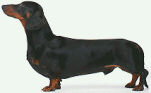
 dachshund
n.
dachshund
n.- from Dachshund "badger hound": a small dog
of a breed of German origin originally used to hunt badgers. In
German-speaking countries dachshunds are more often called Dackel
nowadays, but also Dachsel and Dachser.
- "On the carpet in front of the fire, a pretty little
dachshund was curled up asleep with its nose tucked into its
belly." Roald Dahl, "The Landlady", Kiss Kiss, 1959, p. 10.
- "'Who ever heard of a German without a dachshund?'"
Christopher Morley, The Haunted Bookshop, 1918.
- "'I'm raising a dachshund now—by your
methods.'" Robert A. Heinlein, Starship Troopers, 1959.
- Contemporary Dachshund, by Eileen
Falconer-Douglas, 1999.
- The Dachshund: A Dog for Town and
Country, by Ann Gordon, 2001.
- More books and products related to dachshund
- das ist gut
- "that is good": a phrase used in English-language
media without translation because it is easily understood while still
sounding very German.
 "Does he
have DAS?"
"Does he
have DAS?"
"DAS what?"
"Das ist gut."
"Damage Avoidance System."
A.I. - Artificial Intelligence, directed
by Steven Spielberg, 2001.- "'Das ist gut.' 'Die Engel-kinder!' cried the poor
things, as they ate, and warmed their purple hands at the comfortable
blaze." Louisa May Alcott, Little Women, 1869, p. 14.
- "It was given to men of square determined stature with
grim reliability and efficient ways to work and tend these slopes and
gather the harvest. God saw das ist was gut and he rested." Ralph
Steadman, The Grapes of Ralph: Wine According to
Ralph Steadman, 1996, p. 78. This is intentionally horrible grammar.
Correct German would be, "Gott sah, dass es gut war..."
- deaner n.
- See diener.
 deckel, deckle n.
- from Deckel "cover, lid": a paper-making
frame; the rough edge on paper or other materials (as if) left by a
deckel (deckel edge, featheredge); a metal plate with a pattern punched
out of it and placed in front of a light to produce an outline on a
stage; a cut of beef over the shoulder of the steer (deckel meat, blade
meat) [< German Deckel "little covering" < Decke
"covering" < decken "to cover" < Old
High German decchen]. This entry suggested by Jan Neidhardt.
- "Nothing on the walls, with one exception: Tacked over
the bed was [a yellowed, deckel-edged photograph]." Douglas Biber
et al., Longman Grammar of Spoken and Written
English, 1999, p. 906.
- "From the station to the Lycée it was like a
promenade through the Danzig Corridor, all deckle-edged, crannied,
nerve-ridden." Henry Miller, Tropic of Cancer, 1987, p. 279.
- "These two frames are officially called a mould and
deckle." Audrey Niffenegger, The Time Traveler's Wife, 2004, p. 371.
- "I went to the studio and scrubbed molds and deckles and
drank my coffee, but I wasn't enjoying myself because I couldn't
figure out what Henry's problem was." Susan Wise Bauer, The Story of the World: Activity Book
One: Ancient Times, 2003, p. 116.
- "Say good-bye to club steaks, Newport steaks, flanken,
deckel." Christopher Kimball, The Cook's Bible: The Best of American
Home Cooking, 1996, p. 233. "Flanken" is German for
"sides".
- "Some markets with a large Jewish clientele carry a cut
of beef known as 'deckel' which pulls easily into long shreds when
cooked. If you can get it, it is far cheaper than flank steak."
Zarela Martínez, Food from My Heart: Cuisines of Mexico
Remembered and Reimagined, 1995, p. 176.
- More books and products related to deckle
- delicatessen, deli n.
- from Delikatessen (-laden, -geschäft)
"(shop of) delicacies": ready-to-eat, often unusual or
foreign foods; a shop where such foods are sold [German Delikatessen,
Delicatessen "delicacies" < Delikatesse,
Delicatesse "delicacy" < French délicatesse
"delicacy" < Old Italian delicatezza
"delicacy" < delicato "delicate" <
Latin delicatus; the notion that Delikatessen comes
from German delikat "delicate, fine" + Essen
"food" is a folk etymology and therefore incorrect].
 "In order to do this,
many pathologists have taken to describing diseased organs as if they
were food, earning themselves the name, delicatessen
pathologists." Michael Crichton writing as Jeffery Hudson, A Case of Need, 1968.
"In order to do this,
many pathologists have taken to describing diseased organs as if they
were food, earning themselves the name, delicatessen
pathologists." Michael Crichton writing as Jeffery Hudson, A Case of Need, 1968.- "The Porsche jumped the curb, plowed through a stack of
black plastic garbage bags, and crashed through the plate glass window
of a small delicatessen that was closed for the night." Janet
Evanovich, Eleven on Top (A Stephanie Plum Novel),
2005, p. 69.
- "The place [the Bagel Bin on Little Santa Monica] was
New Age Deli: glass cases of smoked fish and meat and all the right
salads, but the stainless-steel/vinyl ambience was autopsy room."
Jonathan Kellerman, Rage (An Alex Delaware Novel), 2005, p.
176.
- "Though they had few servants, yet with gas stoves,
electric ranges and dish-washers and vacuum cleaners, and tiled
kitchen walls, their houses were so convenient that they had little
housework, and much of their food came from bakeries and
delicatessens." Sinclair Lewis, Babbitt, 1922.
- "At one point a thirty-minute meal break was called and
three or four of our company hurried across the street to a small
restaurant-deli." Steve Allen, Dumbth: The Lost Art of Thinking, With
101 Ways to Reason Better and Improve Your Mind, 1998, p.101-2.
- "The stories are not those I expect to hear, of people
getting sick from drinking unpasteurized milk or eating deviled eggs
left too long in the hot sun at a picnic, but tales of peopled
sickened by contaminated parsley and scallions, cantaloupes, leaf
lettuce, sprouts, orange juice, and almonds; refrigerated potato
salad, eggs, chicken, salami, and beans; hot dogs, hamburgers, deli meats." Jennifer
Ackerman, "Food: How Safe?" National Geographic, May 2002, p. 9.
- Delicatessen One, by Various Artists,
1999.
- More CDs and products related to delicatessen
- More books and products related to deli
- Der
Freischütz n.
- See Freischütz,
Der.
- der Führer n.
- See Führer.
- Der Kindestod n.
- See Kindestod, Der.
- Der Weihnachtsbaum n.
- See Weihnachtsbaum,
Der.
- Deutsche Bundesbank n.
- See Bundesbank.
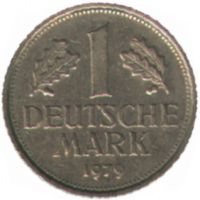 deutsche
mark, deutschemark, Deutsche
mark, Deutschemark, Deutschmark,
D-mark, DM, DEM
n. [pl. Deutschemark, Deutschemarks, Deutschmarks
deutsche
mark, deutschemark, Deutsche
mark, Deutschemark, Deutschmark,
D-mark, DM, DEM
n. [pl. Deutschemark, Deutschemarks, Deutschmarks
 ]
]- from deutsche Mark "German mark". See
further examples under Commerzbank
and Wirtschaftswunder.
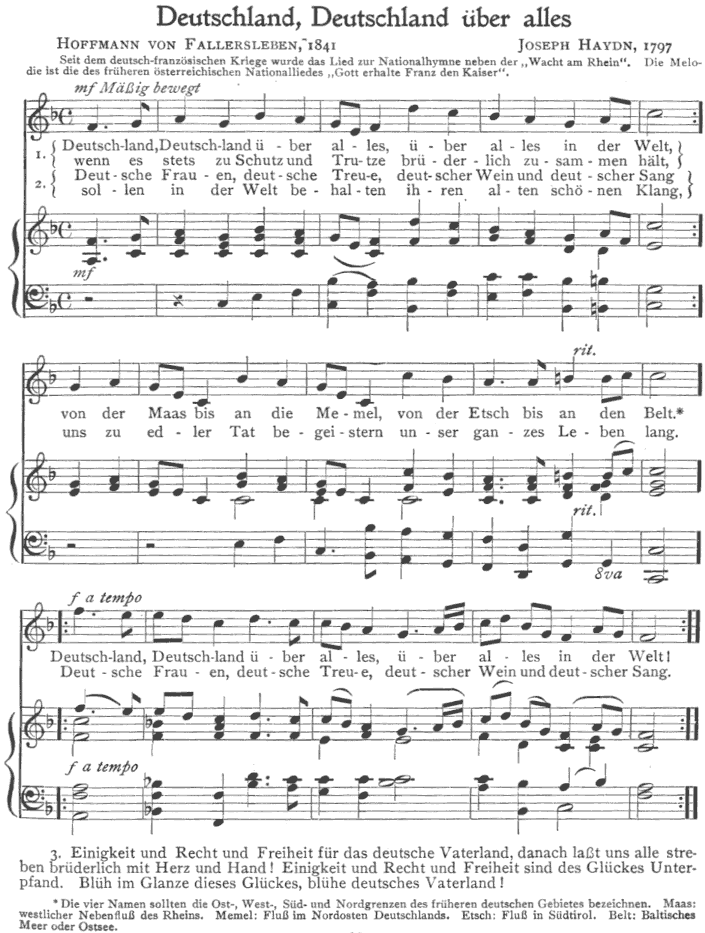
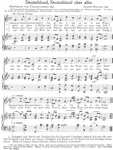 "Deutschland
über alles" n.
"Deutschland
über alles" n.- "Germany over everything": also known as the Deutschlandlied
"Germany song", the national anthem of Germany, sung to the
tune of the Emperor's Hymn or Austria, the Austrian national
anthem from 1797 to 1918, composed by Haydn. The controversial first
verse referring to über alles was replaced in 1950 with
the third verse referring to unity, justice and freedom. The text on the right is from a book
published in 1931. Nowadays Deutschland über alles is a
nationalist slogan. This entry suggested by Wilton Woods. See also
über-.
According to Daniel
Molkentin:
"The [phrase] 'Deutschland über alles' had a completely
different meaning before Hitler started abusing it.
Back when the hymn was composed, Germany was just a loose association
of states which had their own borders and no central government or
emperor. That was a major drawback compared to England or France,
because among other things the economy was hopelessly inefficient
through all the different taxes and currencies inside Germany.
So the Germans had the wish to get some central government/emperor in
place. The first verse tried to express that in the sense of, 'Put all
your energy into (a united) Germany; it's more important for us to
achieve that than anything else' ('anything else' being 'the world',
you probably say 'the universe' today).
The first to abuse that in the way of, 'Germany is better [than] every
other nation in the world', were Adolf Hitler and the Nazis, just as they made other stuff fit with
their Weltanschauung
(another German word, funny :)."
- "Just as the Prussian military caste had its slogan
'Deutschland ueber Alles!' so the Knights of Slavery have their
slogan: 'Make America Catholic!'" Upton Sinclair, The Profits of Religion: An Essay in Economic
Interpretation, 1918, p. 126.
- "Other fun bumper stickers can say things like, BEER
DRINKERS GET MORE HEAD; SUCK MY TAILPIPE; HONK IF YOU'RE HORNY; HOORAY
FOR THE KKK; or DEUTSCHLAND UBER ALLES." George Hayduke, Getting Even: The Complete Book of Dirty Tricks.
- "The virtuous German had been advancing heroically with
the double desire of enlarging his country and of making valuable
gifts to his offspring. 'Deutschland uber alles!' But their most
cherished illusions had fallen into the burial ditch in company with
thousands of comrades-at-arms fed on the same dreams." Vicente
Blasco Ibanez, The Four Horsemen of the Apocalypse.
- Die Hand die Verletzt n.
- See Hand die
Verletzt, Die.
- diener, deaner
n.
- from Diener "servant": a man-of-all-work in
a laboratory (Dorland's Illustrated Medical Dictionary),
morgue attendant, pathology or autopsy assistant. (Special thanks to
all the helpful medical transcriptionists in sci.med.transcription.)
- "While the pathologist is doing this, the deaner cuts
the scalp open, removes the scullcap, and takes out the brain if
permission for brain removal has been obtained... Deaner is a
traditional term for a man who takes care of the dissecting room. It
is an ancient term, dating back to the days when anatomy dissections
were done by horse gelders and butchers. The deaner keeps the rooms
clean, cares for the corpses, and aids in the dissection."
Michael Crichton writing as Jeffery Hudson, A Case of Need, 1968.
- "George Rinne, the pathology department's Negro diener—keeper
of the morgue—looked up as the stretcher rolled in." Arthur
Hailey, The Final Diagnosis, 1959.
- "Immediately before the autopsy, the body is removed
from the cooler by a morgue attendant who will help with the autopsy.
This individual is called a diener (DEE-nur), which
is German for 'servant.' Most dieners do not realize the derivation of
this word and would probably object to being called 'diener' if they
did. Dieners are not formally trained, but many have some background
of employment in the funeral industry. For some reason, in the
southern U.S. anyway, about ninety per cent of dieners (my estimate)
are African-American. I would estimate that less than ten per cent of
dieners are female. Dieners tend to work at their job for decades. I
think this is because 1) management types don't know what goes on in
the morgue, and would not care to mess around with its staffing come
belt-tightening time, and 2) dieners are pretty much left alone by
management and enjoy a much greater degree of autonomy than most
workers at their pay grade and level of education. My own impression
of the 'diener personality' is that they are somewhat secretive and
cliquish, and one gets the idea that they have a lot more going on in
their lives than they tend to let on... For fiction writers, I think
there is a lot of character development potential for
dieners...." Ed Uthman, "The
Routine Autopsy".
- "Works under the technical and administrative direction
of a pathologist. Obtains approval and instructions to begin autopsy,
insures correct identification, via I.D. wristband, lays out standard
autopsy instruments and apparel for the pathologist. Labels specimen
jars, fills formalin containers, prepares tissue cassettes, bunsen
burner together with Petri dishes for cultures as requested...."
"Hospital (Diener) Services Autopsy
Support", 1800autopsy.com.
-
Diesel, diesel
adj., n.
- from Diesel: pertaining to a type of
internal-combustion engine in which ignition is caused by heat due to
air compression instead of due to an electric spark as in a gasoline
engine; Diesel engine or motor; Diesel fuel; Diesel automobile or other
vehicle; named for Rudolf Diesel, 1858-1913, German inventor [<
South German diesel "well, healthy" or short for Matthiesel,
diminutive of Matthäus "Matthew"].
- "'Champ is the salt of the earth but somehow I can't
imagine him joining you in symbolic dancing, or making improvements on
the Diesel engine.'" Sinclair Lewis, Main Street, 1920, p. 155.
- "The compression-ignition, or diesel, engine differs in
several ways from the spark-ignition engine, although it is based on
the same two- or four-stroke cycle." Committee on Fuel Economy of
Automobiles and Light Trucks, Automotive Fuel Economy: How Far Should
We Go?, 1992, p. 33.
- "The cold diesel turned over instantly, coughing a bit
uneasily but then rumbling powerfully, and a corner of his mind
congratulated himself for having had it overhauled before he left
port." David Weber, The Apocalypse Troll, 1999.
- "This is the point in the infomercial where the guy
wearing the CAT Diesel cap asks, 'Do I need a college education to
build one of these here multiple-truth Web sites?'" Philip
Greenspun, Philip and Alex's Guide to Web
Publishing, 1999.
- "One of the Diesel engines broke down in the morning,
and while we were working on it, the forward port diving-tank
commenced to fill." Edgar Rice Burroughs, The Land That Time Forgot.
- "This usage is usually found in metaphors that treat
computing power as a fungible commodity good, like a crop yield or
diesel horsepower." Eric S. Raymond, The New Hacker's Dictionary.
- "... the town's sole gas station refused to sell them
diesel for their tractors." Stefan Thiel, "Old Stasi Never Die", Newsweek, Dec. 10, 2001, p. 39.
- More books and products related to diesel
- diktat n.
- from Diktat "dictation, something
dictated": a harsh settlement unilaterally imposed (as on a
defeated nation); decree, order [< New Latin dictatum <
Latin dictatus < dictare "to dictate"].
This entry suggested by Alastair
Lack.
- "Weary Iraq accepts UN diktat", Dominic
Evans, The
Economic Times, June 20, 1998.
- "Democracy is not the diktat of one armed party."
Mesfin Wolde-Mariam, "The Ethiopian Human Rights Council and
Human Rights", Ethiopia on the Web, July 1996.
- "Investment by government diktat"
Robert McKee, World
News Magastories.
- "SEBI diktat on trading with CRB-linked
firms", The
Financial Express, July 8, 1997.
- "It is for that reason that we want to replace the
Diktat, and repair the damage to the Union." David Trimble, "Speech by David Trimble at the Annual
General Meeting of the Ulster Unionist Council", CAIN
Project, Mar. 23, 1996.
-
dirndl n.
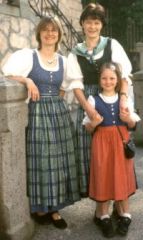
- from Dirndl "dirndl; girl": a woman's dress
with a close-fitting bodice and full skirt, commonly of colorful and
strikingly patterned material, fashioned after Tyrolean or Alpine
peasant wear; a full, gathered skirt attached to a waistband or hip
yoke; any skirt with gathers at the waistband. [German short for Dirndlkleid
"traditional dress" < Bavarian and Austrian German dialect
Dirndl "girl", diminutive of Dirne
"girl" < Middle High German dierne < Old High
German diorna, thiorna + Kleid "dress".]
See further example under yodel.
- "It is a handsome thoroughfare and well worth an amble,
so long as you don't let your gaze pause for one second on any of the
scores of shop windows displaying dirndls and lederhosen, beer mugs with pewter
lids, peaked caps with a feather in the brim, long-stemmed pipes and
hand-carved religious curios." Bill Bryson, Neither Here Nor There: Travels in
Europe, 1991, p. 250.
- "Elvira Wallner, daughter of the pastry chef in St.
Wolfgang, wears a dirndl dress and carries an heirloom handbag."
George W. Long, "Occupied Austria, Outpost of Democracy" National Geographic, Jun. 1951, p. 777.
- "On Thursday nights in north Scottsdale, the hills are
alive with the sound of music—not
Julie-Andrews-twirling-around-in-a-dirndl music, but the kind of music
that makes your feet want to get up and dance." Kurt Repanshek, "A new generation in Yellowstone, western
history gets a new home, revisiting Mount St. Helens", Sunset, Jun. 1995.
- "After all, I'd tried on one of those Laura Ashley
dresses, the ones with puffy short sleeves and wide dirndl skirts in
tiny floral prints." Gina Barreca, "The
Power of an 18-year-old with Hungry Red Lips" The
Hartford Courant, Jan. 29, 2001.
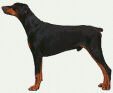 Doberman
pinscher, Dobermann Pinscher, Doberman, pinscher n.
Doberman
pinscher, Dobermann Pinscher, Doberman, pinscher n.
- from Dobermannpinscher "Dobermann's
terrier": a breed of dog first bred by Ludwig Dobermann, 19th
century German dog breeder. See also pinscher.
- "In the meantime he explained the layout of the house
and garden and ordered a full force of Saracen armoured cars, two
hundred policemen armed with Sterling machine guns, German guard dogs
and Dobermann Pinschers to be deployed." Tom Sharpe, Indecent Exposure, 1973, p. 212.
- "No one sat at the bar except a Doberman on the end
stool." Barbara Holland, Bingo Night at the Fire Hall: The Case
for Cows, Orchards, Bake Sales and Fairs, 1997.
- The World of Doberman Pinschers, by Anna
Katherine Nicholas, 1987.
- Doberman Pinscher Champions 1988-1991,
1992.
- More books and products related to Doberman, Dobermann
- dollar n.
- See taler.
- doppelganger, doppelgänger, Doppelgänger,
doubleganger, double-ganger,
double ganger n.
- from Doppelgänger "double goer": the
ghost or wraith of a living person; a double; alter ego; a person who
has the same name as another. See further example under eigen-.
- "He [Harry] watched as his six doppelgängers
rummaged in the sacks, pulling out sets of clothes, putting on
glasses, stuffing their own things away." Joanne K. Rowling, Harry Potter and the Deathly Hallows
(Book 7), 2007, p. 49.
- "This was art, the fruit and expression of
civilization, and the strictly functional schoolbus yellow had given
way to fluorescent purple and cherry-apple red, to doppelgänger green,
Day-Glo orange and shattered pink." T.C. Boyle, Drop
City, 2004, p. 295.
- "'The two women are either related – twins, even
– or they're lookalikes. Well, that's obvious,
Doppelgangers.'" Martha Grimes, The Stargazey: A Richard Jury Mystery,
1998, p. 147. This quote suggested by Volker Knopp.
- "'And she will never allow Slitscan to run that
footage of your doppelgänger.'" William Gibson, Idoru, 1997, p. 363.
- "Ghostly horror by Stephen King's doppelganger."
from a review by the San Francisco Chronicle in Stephen King
writing as Richard Bachman, Desperation, 1996, p. 548.
- "I could scarcely believe that it was I,--that figure
whom they called a Consul,--but a sort of Double Ganger, who had been
permitted to assume my aspect, under which he went through his shadowy
duties with a tolerable show of efficiency, while my real self had
lain, as regarded my proper mode of being and acting, in a state of
suspended animation." Nathaniel Hawthorne, Our Old Home: A Series of English
Sketches, 1883.
- "A species of apparition, similar to what the Germans
call a Double-Ganger, was believed in by the Celtic tribes, and is
still considered as an emblem of misfortune or death." Walter
Scott, A Legend of Montrose.
- More books and products related to doppelganger
-
Doppler adj.
- referring to the Doppler effect
or Doppler radar, e.g. Doppler
shift or Doppler ultrasound.
- to doppler v.i.
- to display the Doppler effect.
- "Zona, the only one telepresent who'd ever seen anything
like a real jungle, had done the audio, providing birdcalls, invisible
but realistically dopplering bugs, and the odd vegetational rustle,
artfully suggesting not snakes but some shy furry thing, soft-pawed
and curious." William Gibson, Idoru, 1997, p. 13.
- "His words were lost in the scream of a ship, dopplering
in at the spaceport behind him." Robert A. Heinlein, Citizen of the Galaxy, 1982, p. 6.
- Doppler effect,
Doppler n.
- from Doppler-Effekt: the effect named for Austrian
physicist Christian Johann Doppler (1803-1853), which explains why
things sound higher pitched when moving toward the observer than when
moving away, and also why stars with different relative speeds to the
earth apparently show different colors [< Middle High German topeler
"dice player, dice maker" < topelstein "a
die, pl. dice"].
 "Smythe unveiled the
next lot, a stereographic sensor array that purported to be able to
detect even cloaked vessels by the Doppler effect they produced in the
subspace continuum." Dafydd ab Hugh, Balance of Power (Star Trek: The Next
Generation), 1995, p. 208.
"Smythe unveiled the
next lot, a stereographic sensor array that purported to be able to
detect even cloaked vessels by the Doppler effect they produced in the
subspace continuum." Dafydd ab Hugh, Balance of Power (Star Trek: The Next
Generation), 1995, p. 208.- "'There was a Doppler effect to his scream as he flew
over us,' a witness reported, 'followed by a loud thud.'" Wendy
Northcutt, The
Darwin Awards, 2000, p. 124.
- Doppler radar,
Doppler n.
- a radar system that uses the Doppler effect for measuring
velocity. This is the radar police use to measure the speed of cars.
- "Naw. My mom's party Doppler picked it up
immediately." Jerry Scott & Jim Borgman, Zits comic strip, Sep. 5, 2004.
- "They didn't have satellite trucks or Doppler radar, or
anything flashy for that matter." David Haynes, Live at Five, 1996.
- "Doppler radar can determine wind speed by measuring the
speed at which precipitation is moving horizontally toward or away
from the radar antenna." C. Donald Ahrens,
"Meteorology", Microsoft® Encarta® 98 Encyclopedia.
- Radars: Cw and Doppler Radar, by David
K. Barton, 1978.
- More books and products related to Doppler radar
- doubleganger, double-ganger, double ganger n.
- See doppelganger.
- drang n.
- See sturm and drang.
- dreck, drek
n.
- related to Dreck "dirt, filth, mud", also
fig.: to quote Steve Hawley:
"Detritus. Useless garbage." [Yiddish drek; German Dreck
< Middle High German drec; related to Old English threax
"rubbish"].
- "... and suddenly I was in a gloopy passage about public
radio as a telephone in a dark forest whereby the brave exchange their
messages (Where did this dreck come from? I thought), and I
felt thoroughly ashamed to be giving a speech this dumb and wasting
everyone's time, I felt bitter shame rise in my throat, I was choking
on it." Garrison Keillor, Wobegon Boy, 1997, p. 121.
- "Damn women writers write about drivel and dreck and
people fawn over them." Garrison Keillor, "Address to the
National Federation of Associations Convention, Minneapolis, June 12,
1993", The Book of Guys, 1993, p. 4.
- Drek!: The Real Yiddish Your Bubbe Never
Taught You, by Yetta Emmes, 1998.
- More books and products related to dreck, drek
 dummkopf n.
- from Dummkopf "dumb-head": stupid person,
dumbbell, blockhead, fool, oaf, dolt [< German dumm
"stupid, dumb" + Kopf "head"]. This entry
suggested by Wilton
Woods.
- Durmstrang n.
- See Sturm und
Drang.
Please do not plagiarize. If you would
like to use this information in a print or electronic publication,
please ask me for
permission first and cite this page as:
Knapp, Robbin D. 2011.
"GermanEnglishWords.com:
D". In Robb:
GermanEnglishWords.com. Mar. 5, 2009.
You can order most of the cited books and other media through Amazon simply by clicking on the titles.

 "Deutschland
über alles" n.
"Deutschland
über alles" n.