from Ganzfeld "whole field": a type of
experiment used in researching psychic experiences [< German ganz
"complete, whole, perfect" < Middle High German ganz
< Old High German ganz + Feld "field"
< Middle High German veld < Old High German feld].
"I am, in fact, the subject of a ganzfeld experiment. Ganzfeld,
German for 'whole field,' refers to the boundless void in which I seem
to be afloat." Kenneth Miller, "Phychics: Science or
Séance?" Life,
June 1998.
from Gasthaus "guest house": a small inn or
hotel in German-speaking countries [< German Gast
"guest" + Haus "house"]. See also Bauhaus, Gasthof
and hausfrau. This entry suggested by Christiane
Leißner.
"For me there will always be one gasthaus in Niessen:
the Niessener Hof." John Wray, The Right Hand of Sleep, 2001.
"They went into the little Gasthaus and got some black
bread and sausage and some milk." Francis Hodgson Burnett, The Lost Prince, 1941, p. 245.
"There were fences to cling to, and leading from the
railway station to the Gasthaus a little path of cinders had been
strewn for the benefit of the wedding guests. The Gasthaus was very
festive." Katherine Mansfield, In a German Pension.
"Every night, in the course of his rambles, his highness
the Sultan (indeed, his port is sublime, as, for the matter of that,
are all the wines in his cellar) sets down with an iron pen, and in
the neatest handwriting in the world, the events and observations of
the day; with the same iron pen he illuminates the leaf of his journal
by the most faithful and delightful sketches of the scenery which he
has witnessed in the course of the four-and-twenty hours; and if he
has dined at an inn or restaurant, gasthaus, posada, albergo, or what
not, invariably inserts into his log-book the bill of fare."
William Makepeace Thackeray, Early and Late Papers Hitherto
Uncollected, 1867, p. 1.
"An example of this kind occurs near the Bernina
Gasthaus, about two hours from Pontresina." John Tyndall, Hours of exercise in the Alps, 1871, p.
226.
"Not far from there is a GASTHAUS whose stucco and
half-timber construction would look echt
in Innsbruck." John Skow, "World Without Walls", Time, Aug. 13, 1990, p. 70.
from Gasthof "guest court": a hotel in
German-speaking countries, usually larger than a Gasthaus
[< German Gast "guest" + Hof
"court, yard, courtyard"]. This entry suggested by Christiane
Leißner.
"Should I walk back to the village, go to the Gasthof,
write a letter craving permission to call on my cousins, and wait
there till an answer came?" Elizabeth von Arnim, Elizabeth and Her German Garden.
gedanken
experimentn.
from Gedankenexperiment "thought
experiment": in physics, an experiment which is only described but
not made in reality as it is not possible or was not possible as
someone thought of it for the first time. This entry and definition
suggested by Hilmar
R. Tuneke.
from Geigerzähler "Geiger counter": an
instrument for detecting and counting particles ionized by radiation
that pass through it, named for Johannes Wilhelm (Hans) Geiger,
1882-1945, German physicist [German Geiger < Middle High
German gîger "violinist" < gige
"violin"]. This entry suggested by Wilton Woods.
"A rad-lab technician came in and checked for leakage
from the plutonium with a Geiger counter." Michael Crichton, Terminal Man, 1988, p. 80.
"An important difference between chemical toxins and
radionuclides is that radioactive contamination is readily detected by
relatively inexpensive Geiger counters, while the TCDD isomer of
dioxin, like many other toxic compounds, can only be determined by use
of a gas chromatograph coupled to a mass spectrometer; the cost of the
latter instruments are in the range of $100,000 to $500,000."
John W. Birks & Sherry L. Stephens, "Possible Toxic
Environments Following a Nuclear War", The Medical Implications of Nuclear War,
1986.
a tube filled with gas that is ionized by passing charged
particles, producing within the tube an electric charge indicative of a
particular particle, named for Johannes Wilhelm (Hans) Geiger,
1882-1945, German physicist.
Geltungn.
from Geltung "validity, recognition":
personal standing, recognition, acceptance, esteem, influence [<
German gelten "to have value, be worth, be valid, hold
good" < Middle High German gelten < Old High German
geltan, related to German Geld "money" + -ung
"-ing"].
from Gemeinschaft "community, communion,
partnership, association, intercourse, fellowship": a social
relationship characterized by strong reciprocal bonds of sentiment and
kinship within a common tradition, a community or society characterized
by this relationship, a fellowship [< German gemein
"(in) common, general" < Middle High German gemein,
gemeine < Old High German gimeini + -schaft
"-ship" < Middle High German -schaft < Old
High German -scaf]. See also gesellschaft.
This entry suggested by Richard
W. Hartzell.
"Their [the communitarian Progressives'] theories echoed
distinctions articulated by contemporaneous social theorists from
Europe—Sir Henry Maine's status versus contract, Ferdinand
Tönnies's Gemeinschaft versus Gesellschaft, Emile Durkheim's
mechanical versus organic solidarity, and Georg Simmel's comparison of
town and metropolis, all expounded between 1860 and 1902." Robert
D. Putnam, Bowling Alone: The Collapse and Revival
of American Community, 2001, p. 380.
"In his seminal study in social anthropology Community
and Society (Gemeinschaft and Gesellschaft), the nineteenth-century
sociologist Ferdinand Toennies concluded that the requisites of
traditional blood and clan communities tended inevitably to yield to
the requisites of voluntary and contractual societies in an evolution
that pointed only forward...." Benjamin Barber, Jihad vs. McWorld: How Globalism and
Tribalism Are Reshaping the World, 1996, p. 161.
"I see the willingness to believe in an epidemic as
resulting in part from a Gemeinschaft-Gesellschaft fallacy
that demonizes industrial or post-industrial society and romanticizes
the supportive nature of communities in prior eras." Peter D.
Kramer, Against Depression, 2005, p. 313.
"Perhaps it is our guilt that has directed our attention
to these areas of crass 'pseudo-gemeinschaft,' for there is
hardly a performance, in whatever area of life, which does not rely on
the personal touch to exaggerate the uniqueness of the transactions
between performer and audience." Erving Goffman, The Presentation of Self in Everyday
Life, 1959, p. 50.
"All EU member states strive toward achieving a European
Gemeinschaft without anticipating a particular political
framework such as a federation, confederation or European
commonwealth." David Huang, translated by Wang Hsiao-Wen, "EU-style integration offers hope"Taipei
Times, Jun. 9, 2004, p. 8.
from gemütlich "cozy, comfortable,
easy-going, good-natured": congenial, agreeable [German gemütlich
< Late Middle High German gemüetlich "concerning
the disposition, pleasant, agreeable" < Middle High German gemüete
"disposition, nature, feelings, mood" and separately < Old
High German gimuati "of the same nature, pleasant,
agreeable"]. This entry suggested by Christiane
Leißner.
"Everybody is at least plump in this comfortable, gemutlich
town, where everybody placidly locks his shop or office and goes home
at noon to dine heavily on soup and meat and vegetables and pudding,
washed down by the inevitable beer and followed by forty winks on the
dining room sofa with the German Zeitung spread comfortably
over the head as protection against the flies." Edna Ferber, Dawn O'Hara, The Girl Who Laughed, p.
89. Zeitung means "newspaper".
"This get-together after Midnight Mass in the Christmas
Room, which is filled with that indescribable 'Christmas
smell'--compounded of wax candles, 'Lebkuchen'
and balsam fir--has such a very special quality that even the word
'gemutlich' becomes inadequate." Maria Augusta Trapp, Around the Year with the Trapp Family.
"I reviewed Gatti's first Mahler Symphony recording, the
Fifth in glowing terms (July/Aug 1998) and am
also delighted with this lovely, gemutlich Fourth." Gerald S.
Fox, "Mahler: Symphony 4; 4 Early Songs", American
Record Guide, Mar. 2000.
"With its open core and rotunda, it is like a fetching
little gemutlich miniature of the vertiginous main hall." Kurt
Andersen, "Finally Doing Right By Wright: After years of fuss and
furor, the great but inhospitable Guggenheim gets a splendid
overhaul", Time, Jul. 6, 1992, p. 64.
"And then there was Francis Coppola, the gemutlich
Godfather at age 59, back from visiting his daughter, Sofia, on
location of a movie she is directing and buzzing about new
entrepreneurial adventures for his beloved, if battle-scarred,
Zoetrope company." Peter Bart, "'George and Francis show'
returns", Variety, Jul. 27, 1998, p. 64.
"The woman was visiting Le Pain Quotidian--among the
more gemutlich of bakeries--when she decided that it wouldn't be
imprudent to park her child's $200 Concorde MacLaren X267 stroller in
the vestibule." Ralph Gardner, Jr., "The Crime
Blotter", The New York Observer, Mar. 4, 2002.
"At the height of her success, [Julia] Child could boast
a clutch of bestselling cookbooks and a gemütlich TV
show shot on a single set." Margaret Talbot, "Les
Très Riches Heures de Martha Stewart", <boldtype>,
Oct. 1997.
from Gemütlichkeit "congeniality":
warm friendliness, amicability [< German gemütlich].
"Since I have lived in this pretty town I have become a
worshiper of the goddess Gemutlichkeit." Edna Ferber, Dawn O'Hara, The Girl Who Laughed.
"The lodge is friendly, unpretentious and full of
tropical Gemutlichkeit." Robert Hughes, "Blissing Out in
Balmy Belize", Time, Apr. 22, 1991, p. 92.
"In her youth she adored eating, drinking and singing in
the beer halls of Munich, and this German enclave at 2015 New Highway
(391-9500), owned by Privatbrauerei Hoepfner Brewery in Karlsruhe and
its American partners, recreates the gemutlichkeit of its European
counterpart." Richard Jay Scholem, "A La Carte; Cars, Very
New and Very Old", The New York Times, Oct. 11, 1998. Privatbrauerei
means "private brewery".
from Gesellschaft "companionship, association,
company, society, fellowship, club": a rationally developed
mechanistic type of social relationship characterized by impersonally
contracted associations between persons, a community or society
characterized by this relationship [< German Geselle
"appentice" < Middle High German geselle
"friend, companion, comrade, consort, mate" < Old High
German gisello, gisellio + -schaft "-ship"
< Middle High German -schaft < Old High German -scaf].
See also gemeinschaft.
"Know your place, said/The leader, which is
together,/And clubbed the errant back,/Giving it the
Gesellschaft." John M. Burns, "Conform" BioGraffiti:
A Natural Selection, 1981.
"The Bach Gesellschaft, formed in 1850, devoted itself
assiduously to finding, editing, and publishing Bach's works."
Wilfrid Mellers, "Bach, Johann Sebastian" Microsoft® Encarta® 96 Encyclopedia,
1996.
from Gestalt "form, figure, shape, frame,
stature": in Gestalt psychology, a synthesis of separate elements
of emotion, experience, etc., that constitutes more than the mechanical
sum of the parts. See also ArtLex.
"As for the rest, the cast of characters had changed
somewhat—Reba was at the stove now, making a casserole to go with
the soup, and Alfredo was hunkered over a game of solitaire at the
kitchen table while Che and Sunshine hurtled in and out of the room in
a sustained frenzy that might have been called tag or hide-and-go-seek
or gestalt therapy." T.C. Boyle, Drop
City, 2004, p. 183.
"But if you look more carefully, you might observe that
the general gestalt of the [DNA] sequences is roughly the same."
Jonathan Marks, What
It Means to Be 98% Chimpanzee, 2003, p. 25.
"Understand the gestalt in this easy-to-remember
history." Wendy Northcutt, The
Darwin Awards II, 2001, p. 1.
"His photographs came to be a distinctive element of
hundreds of album covers, which helped to define the unique Blue Note
gestalt." M. Cuscuna, C. Lourie and O. Schnider, The Blue Note Years: The Jazz
Photography of Francis Wolf, 1995.
"Similarly, group dynamics was perceived as
old-fashioned, a field that had seen its heyday in the Gestalt
encounter groups and corporate brainstorming procedures of the early
1970s but now was dated and passé." Michael Crichton, Sphere, 1987, p. 13.
"'We need a new political gestalt in America: an
expansion of the political arena to more accurately reflect not only
what we do, but who we are and are becoming.'" Marianne
Williamson, The Healing of America, 1997.
"Much more an enormous pig than a sort of horse,/Hippo
lives, as a matter of course,/Both in water—still or running,
fresh or salt—/And on adjacent land, where its Gestalt/Takes
fifty pounds (dry weight) of grass per night." John M. Burns,
"Hippopotamus amphibius" BioGraffiti:
A Natural Selection, 1981.
short for Geheime Staatspolizei "Secret State
Police": the terrorist political police of the Nazi regime.
"You can't scare
me with this Gestapo crap." Keanu Reeves as Neo in Matrix, 1999.
"William Casey, an Allied Intelligence officer, later
recalled being told in early May 1945 that the Werewolf organisation
was in process of formation and that it was to be built on the
framework of the Gestapo and other Nazi security services." Ada
Petrova & Peter Watson, The Death of Hitler: The Full Story With
New Evidence from Secret Russian Archives, 1996.
"Even in the early decades of the twentieth century,
telescoped words and phrases had been one of the characteristic
features of political language; and it had been noticed that the
tendency to use abbreviations of this kind was most marked in
totalitarian countries and totalitarian organizations. Examples were
such words as Nazi, Gestapo,
Comintern, Inprecorr, Agitprop. In the beginning the practice had been
as it were instinctively, but in Newspeak it was used with a conscious
purpose." George Orwell, 1984, 1949, p. 252.
from Gesundheit "healthiness": used to wish
someone good health specially to one who has just sneezed. (As a kid I
always thought gesundheit literally meant "bless
you" in German.)
"Whether you call it pop or soda, bucket or pail, baby
carriage or baby buggy, scat or gesundheit, the beach or the
shore—all these and countless others tell us a little something
about where you come from." Bill Bryson, The Mother Tongue: English and How it
Got that Way, 1990, p. 99.
from Gleichschaltung "equalization": the
standardization of political, economic, and social institutions in
authoritarian states [< German gleich "same,
equal" + Schaltung "switching" < schalten
"to switch"]. This entry suggested by Christiane
Leißner.
"Simultaneously, the 'Gleichschaltung' (equalization)
started; that is to say that the personnel of all offices and
institutions of the Government or under Government control became
subject to substitution by reliable members of the German National
Socialist Party." Gabor Baross, Hungary and Hitler, 1964.
"The findings of this study are not dramatically new,
but they provide a nicely nuanced outline of both the complexity of
the time and the diversity of the individual actors and their
disillusionment as they came face to face with the full implications
of Gleichschaltung, which gradually demonstrated an unanticipated
authority and discomfiting militancy and brutality." Larry
Thornton, "On the Road to the Wolf's Lair: German
Resistance to Hitler", review of the book by Theodore S. Hamerow, Historian,
Fall 1999.
"Throughout these first years of the Third Reich, Hitler imposed a process that the Nazis called Gleichschaltung, which means
standardization or making things the same." "Road to
War", Time, Aug. 28, 1989, p. 40.
"Not much comfort here, then, for those now busily
intent upon a historical Gleichschaltung of all Irish
'traditions'." K. Theodore Hoppen, "An Ascendancy Army: The
Irish Yeomanry, 1796-1834", English Historical Review,
Jun. 1999.
"This remarkable gathering at Germany's most hallowed
literary shrine, the town of Schiller and Goethe, was in fact a
tradition that had survived Nazi
Gleichschaltung." Gerwin Strobl, "Shakespeare and the
Nazis", History Today, May 1997.
"In the name of modernization, Reza Shah mounted one of
the most frightful manifestations of fascist statism in modern
history, eliminating all autonomous centers of voluntary association,
generating a Gleichschaltung program very similar to Hitler's agenda
in the contemporary Germany." Hamid Dabashi, "The End of
Islamic Ideology", Social Research, Summer 2000.
"Axel Goodbody, Dennis Tate, and Ian Wallace refute a
simplistic equation of the German Democratic Republic with the NS-politics of Gleichschaltung, or mass
control through ideological uniformity, by charting criticism internal
to that state." Karen H. Jankowsky, "German
Cultural Studies: An Introduction", Criticism, Winter
1998.
glitzn., v.t., glitzyadj.
related to Glitzer, glitzern "glitter, to
glitter": extravagant showiness, glitter [perh. < Yiddish,
perh. < German glitzern "to glitter"
< Middle High German glitzen "to glitter"].
"Behind the glitz and silliness of the 'multimedia
extravaganza' view of the Net touted by the mass media, this 'old
Internet' is still chugging along, growing every day." Evan
Morris, The Book Lover's Guide to the Internet, 1998, p.
12.
"My enchantment with new things, my vulnerability to the
hopeful glitz of even garish packaging has really not
diminished." Alan Shapiro, The Last Happy Occasion, 1996.
"Clouded by event, and stripped of glitz, this year's
Toronto Film Festival let the movies shine through", Richard
Corliss, "An Unfestive Festival", Time, Oct. 8, 2001, p. 65.
"'If a person's into glitz, Rico's not for them.'"
Dave Hill, in Carol Horner, "ZipUSA: Rico, Colorado", National Geographic, Mar. 2001, p. 128.
from Gneis "gneiss": a rock resembling
granite, consisting of alternating layers of different minerals, such
as feldspar, quartz,
mica, and hornblende [probably from
Middle High German gneist, ganeist "a spark" and Old
High German gneisto "a spark" due to the luster of
some of the components]. See further example under quartzite.
"It has been remarked, with much truth, that abruptly
conical hills are characteristic of the formation which Humboldt
designates as gneiss-granite." Charles Darwin, "Rio de
Janeiro" The Voyage of the Beagle, 1836.
"You sprawl face down on a sloping pavement of gneiss,
pressed to the rock by the weight of your pack, and lie there for some
minutes, reflecting in a distant, out-of-body way that you have never
before looked this closely at anything in the natural world since you
were four years old and had your first magnifying glass." Bill
Bryson, A Walk in the Woods, 1997.
götterdämmerung,
Götterdämmerung, Götterdämmerung, Die
Götterdämmerungn.
from Götterdämmerung "twilight of the
gods": in Germanic mythology, the destruction of the gods and of
all things in a final battle with evil powers resulting in the end of
the world, also called Ragnarok in Scandinavian mythology; the final
opera of Richard Wagner's The Ring of the Nibelung on this
theme; a collapse (as of a society, regime or institution) marked by
catastrophic violence and disorder [< German Götter
(plural of Gott "god") + Dämmerung
"twilight" < erroneous translation of Old Icelandic Ragnarôk
"fate of the gods" misunderstood as Ragnarökkr
"twilight of the gods"]. This entry suggested by Wilton Woods.
"She died. Almost a month ago. I guess she'd been ill,
and she thought she didn't have long, so she treated herself to a
steak dinner and took all her cats and went and sat in her Cadillac in
the garage and turned on the engine while her CD player was doing the
immolation scene from Die Götterdämmerung."
Garrison Keillor, Wobegon Boy, 1997, p. 269.
"There were, she told him, rehearsals not only for
'Walkure,' but also for 'Gotterdammerung,' in which she was to sing Waltraute
two weeks later." Willa Silbert Cather, The Song of the Lark, p. 470.
"Even the Hudson and the Susquehanna--perhaps the
Potomac itself--had often risen to drown out the gods of Walhalla, and
one could hardly listen to the 'Gotterdammerung' in New York, among
throngs of intense young enthusiasts, without paroxysms of nervous
excitement that toned down to musical philistinism at Baireuth, as
though the gods were Bavarian composers." Henry Adams, The Education of Henry Adams.
"The Ring consists of four plays, intended to be
performed on four successive evenings, entitled The Rhine Gold (a
prologue to the other three), The Valkyries, Siegfried, and Night
Falls On The Gods; or, in the original German, Das Rheingold, Die
Walkure, Siegfried, and Die Gotterdammerung." George Bernard
Shaw, The Perfect Wagnerite: A Commentary on the
Niblung's Ring.
from Großwetterlage "general weather
situation": the sea-level pressure distribution averaged over a
period during which the essential characteristics of the atmospheric
circulation over a large region remain nearly unchanged (definition
from the Glossary
of Oceanography and the Related Geosciences) [German groß
"large, great" + Wetter "weather" + Lage
"situation, position"]. This entry suggested by Volker Landgraf.



 gemeinschaft, Gemeinschaft, Gemeinschaft n.

 "You can't scare
me with this Gestapo crap." Keanu Reeves as Neo in Matrix, 1999.
"You can't scare
me with this Gestapo crap." Keanu Reeves as Neo in Matrix, 1999.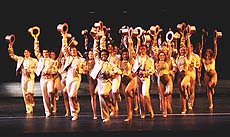 glitz
n., v.t., glitzy adj.
glitz
n., v.t., glitzy adj.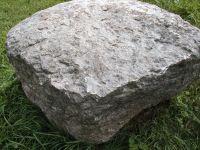
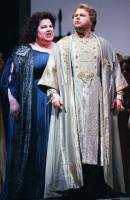 götterdämmerung,
Götterdämmerung, Götterdämmerung, Die
Götterdämmerung n.
götterdämmerung,
Götterdämmerung, Götterdämmerung, Die
Götterdämmerung n. Götterdämmerung (Twilight of
the Gods): In Full Score, by Richard Wagner.
Götterdämmerung (Twilight of
the Gods): In Full Score, by Richard Wagner.