 panzer
adj., n.
panzer
adj., n.- from Panzer, Panzer- "armor, armored":
armored, belonging to an armored division; a vehicle, especially a
tank, in a panzer division [German Panzer "armor"
< Middle High German panzier "breast armor" <
Old French pancier, panciere "coat of mail, literally
belly piece", pance "belly" < Italian panzia,
pancia "belly" < Latin pantex, panticis
"belly", related to paunch].
- "Intelligence reports had indicated that the Finns had
only a few old light-weight tanks and probably fewer than 100
small-caliber anti-panzer guns." Eloise Engle & Lauri
Paananen, The Winter War: The Soviet Attack on
Finland 1939-1940, 1973, p. 4.
- "By 4 February, however, it was seen that this
reinforcement was not enough to crush the Anzio beachhead and General
Jodl asked Hitler for permission to move in the 9th SS Panzer Division, the only fully combat
ready armored division in France." Gordon A. Harrison, European Theatre of Operations:
Cross-Channel Attack, 1993, p. 234.
- "Heinrich Jäger stuck his head and torso up through
the open cupola of his Panzer V for a look around, then ducked back
down into the turret of the panzer." Harry Turtledove, Upsetting the Balance (Worldwar Series,
Volume 3), 1996.
- "In the spring of 1940, when Germany was making its
lightning strikes into the Netherlands, Belgium, and Luxembourg, the Nazis had 2.2 million troops in uniform,
nine motorized divisions, and ten panzer divisions protected by 3,500
combat aircraft." Tom Brokaw, An Album of Memories: Personal Histories
from the Greatest Generation, 2001.
- "Stalingrad's five-month trial by fire began on August
23, 1942, when the first panzer grenadiers of the German Sixth Army
reached the Volga on the city's northern outskirts." David L.
Robbins, War of the Rats: A Novel, 2000.
- More books and products related to panzer
- patzer n.
- probably from Patzer "bungler": a poor or
amateurish chess player [German patzen "to
blunder"]. This entry suggested by Andreas Kempf.
- "I'm a 'patzer,' a chess player who knows how to move
the pieces fairly well but is forever doomed to mediocrity." Mike
Adams, "Check mate; Game brings out the best and the worst in
many players" The Baltimore Sun, Jan. 11, 1999.
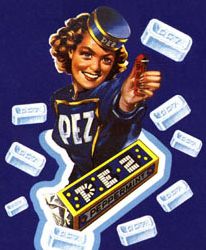 Pez, PEZ
n.
Pez, PEZ
n.- short for Pfefferminz "peppermint" (the
first, middle and last letters): a brand of candy invented by the
Edward Haas company of Vienna, Austria, in 1927, originally with
peppermint flavor as an alternative to smoking, now sold with plastic
dispensers that have heads of familiar characters and are collectors'
items [German Pfefferminz "peppermint" < Pfeffer
"pepper" + Minze "mint"]. See also hasenpfeffer.
- "'They collect Elvis everything--plates, towels, napkin
holders, we even have an Elvis Pez dispenser.' 'They have Elvis Pez
heads?' 'Some lunatic collector in Alabama put sideburns on a Fred
Flintstone Pez, filed down the nose, and painted on sunglasses.'"
Brad Meltzer, The Tenth Justice, 1997.
- "Wesley collected PEZ dispensers, and she mentioned that
since they had moved from Boston to Silicon Valley, she was having
trouble finding fellow collectors to trade with." Adam Cohen, The Perfect Store: Inside eBay, 2002.
- "He realizes he's a lucky monkey, someone who made an
accidental $50,000 guessing that eBay, a Web site designed for buying
and selling Pez dispensers, would emerge with a market capitalization
comparable to General Motors." Thomas A. Bass, "Don't Quit
the Night Job", The New York Times, Apr. 23, 2000,
review of Dumb Money: Confessions of a Day Trader,
by Joey Anuff & Gary Wolf.
- "WHEN THE WEB WAS really young, cyberspace was dominated
by academia and personal home pages were dedicated to pressing topics
like spelunking and Pez dispensers, the online community's response to
proposals of governmental regulation was a consistent and resounding
'hands off.'" Justin Oppelaar, "Sign on the Dot-Com
Line", Variety, Dec. 18, 2000.
- "4th Annual Los Angeles PEZ-A-THON/MAR. 26-27.
Twenty-five hundred Pezheads gather to buy and sell thousands of Pez
dispensers and search for the long-lost '63 Bullwinkle Mom tossed
aeons ago." Gia Gittleson, "the guide", Los Angeles Magazine, Apr. 1999.
- "Simple bead kits, a deck of cards, a Pez candy
dispenser - all will be received as cherished treasure by the child
who keeps asking, 'When are we going to get there?'"
"Destinations & detours: California family travel
planner", Sunset, May 1996.
- Collectors Guide to Pez: Identification
and Price Guide, by Shawn Peterson, 2001.
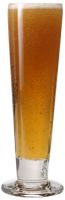 pils,
pilsner, Pilsner, pilsener, Pilsener n.,
adj.
pils,
pilsner, Pilsner, pilsener, Pilsener n.,
adj.- from Pils, Pilsner, Pilsener "of Pilsen": a
pale, light lager beer originally brewed
in Pilsen, Bohemia, Czech Republic; Pilsner glass, a tall glass tapered
at the bottom used especially for beer [German Pils shortened
from Pilsner, Pilsener < German Pilsen < Czech
Plzen].
- "I believe I may even have failed to notice them edging
away when, emboldened by seven or eight glasses of Jupiler pils or the
memorably named Donkle Beer, I would lean towards one of them and say
in a quiet but friendly voice, 'Je m'appelle Guillaume. L'habite Des
Moines.'" Bill Bryson, Neither Here nor There: Travels in
Europe, 1991, p. 20.
- "NATASHA LYONNE: What kind of beer do you have? CHLOE
SEVIGNY: A Pilsner." Gus Van Sant, "The Bonnie and Clyde of
Indie Film", Interview, Nov. 1999.
- "Today the spectrum of beer flavors runs from the crisp,
slightly hoppy freshness of pale, European-style pilsners to the
creamy-sweet maltiness of an English-style brown ale." Jeff
Phillips, "Beer! And the foods that love it", Sunset, Oct. 1996.
- "When the project is done, fill your 'window sill' with
technicolor flowers, such as these gerber daisies lined up in pilsner
glasses." Rebecca Jerdee, "Weekend decorating", Better Homes and Gardens, Aug. 1996.
- "If Eloise had made it past adolescence, she might well
have been smoking Marlboro Lights, drinking Pilsner beer and belching
freely, as Ms. Roi was on a recent evening as she sat on a couch in
her mother's hotel, next to her boyfriend of four months, Marc
Beckman." Alexandra Jacobs, "Alice Roi, the 25-Year-Old
Designer, Is Thinking Girl's Anti-Shoshanna", The New York Observer, May 7, 2001.
- More books and products related to pilsner
- More books and products related to pilsener
- pinscher n.
- from Pinscher "terrier": a breed of dog
[origin unclear but probably from Pinzgauer "from the
region of Pinzgau in the province of Salzburg in Austria"]. See
also Doberman pinscher.
 plattenbau n.
- from Plattenbau "panel building": a
building whose facade is constructed of large, prefabricated concrete
slabs, often found in eastern Europe [German Platte
"panel, plate, sheet" + Bau "building,
construction"]. This entry suggested by Christiane
Leißner. See also Bauhaus.
- "For a generation of West Germans, to whom East Germany
was synonymous with ugly, old-fashioned and second-rate, nothing
symbolized that inferiority better than plattenbaus, the high-rise
apartment buildings from the postwar period that sprawled endlessly
over the Communist landscape." Alisa Roth, "In Chic New
Berlin, Ugly Is Way Cool", The New York Times, Jan. 24,
2002.
- "Plattenbau (Bosna), 2000, is an exact copy of an
entrance to a government-planned high-rise apartment block that had
been built using prefabricated panels." Harald Fricke,
"Sabine Hornig", ArtForum, Apr. 2000.
- polka n., adj.,
v.i.
- from Polka: a fast dance for couples developed in
Bohemia, Czech Republic; music for this dance; to dance the polka; of
the polka, as in polka dots [< German Polka &
French polka < Czech polka "Polish
dance" < Polish Polka "a Polish woman"]. See
further example under lederhosen.
- "He was wearing a wide-collared polka-dot shirt, yellow
on black." T.C. Boyle, Drop
City, 2004, p. 130.
- "My great-grandfather John Tollefson was not a pietist,
he was one of the Happy Lutherans: he loved to dance the polka, which
is a Norwegian martial art, and to drink beer and tell jokes."
Garrison Keillor, Wobegon Boy, 1997, p. 46.
- "Thalassa's leading composer had contrived a witty
musical score beginning with a slow pavane and culminating in a
breathless polka—slowing down to normal speed again at the very
end as the final block of ice was jockeyed into position." Arthur
C. Clarke, The Songs of Distant Earth, 1986, p.
282.
- "She picked out some things by Caruso and Tetrazzini and
piled them on a chair, but James had things to himself up there, and
played The Spring Chicken through three times during dinner, with Miss
Cobb glaring at the gallery until the back of her neck ached, and the
dining-room girls waltzing in with the
dishes and polka-ing out." Mary Roberts Rinehart, Where There's a Will, 1912, p. 178. Polka-ing
can also be spelled polkaing.
- "When they reached the ballroom the band was striking up
a polka, and presently Mr Bunker, with his accustomed grace, was
tearing round the room with Lady Muriel, while the Baron -- the
delight of all eyes in his red waistcoat -- led out her sister."
J. Storer Clouston, The Lunatic at Large, 1905, p. 103.
- "The hall was empty, and they had a grand polka, for
Laurie danced well, and taught her the German step, which delighted
Jo, being full of swing and spring." Louisa May Alcott, Little Women, 1869.
- "And now we began with waltzes,
which passed into polkas, which subsided into other round dances; and
then in very exhaustion we fell back in a grave quadrille."
Edward Everett Hale, The Brick Moon and Other Stories, 1809,
p. 353.
- More books and products related to polka
- poltergeist n.
- from Poltergeist "noisy ghost": a spirit
reputed to make much noise [< German poltern < boldern
"to be noisy, make noise" (onomatopoeic) + German Geist <
Middle High German geist < Old High German geist
"ghost, spook, spirit, essence"]. See also hopfgeist,
zeitgeist.
- "He [Harry] expected to encounter an obstacle at any
moment; his worst fear was Peeves, and he strained his ears with every
step to hear the first, telltale signs of the poltergeist's
approach." J.K. Rowling, Harry Potter and the Deathly Hallows
(Book 7), 2007, p. 472.
- "Harry looked up, and saw, floating twenty feet above
them, Peeves the poltergeist, a little man in a bell-covered hat and
orange bow-tie, his wide malicious face contorted with concentration
as he took aim again." J.K. Rowling, Harry
Potter and the Goblet of Fire (Book 4), 2000, p. 152. This is one
of four German words mentioned in this book. The others are burger, rucksack and waltz.
- "He led them along the deserted corridor and around a
corner, where the first thing they saw was Peeves the poltergeist, who
was floating upside-down in mid-air and stuffing the nearest keyhole
with chewing gum." Joanne K. Rowling, Harry Potter and the Prisoner of Azkaban
(Book 3), 1999, p. 99. This is the only German word mentioned in
this book.
- "Peeves was the school poltergeist, a grinning, airborne
menace who lived to cause havoc and distress." Joanne K. Rowling,
Harry Potter and the Chamber of Secrets
(Book 2), 1999, p. 126. This is one of only two German words
mentioned in this book. The other is waltz.
- "Nearly Headless Nick was always happy to point new
Gryffindors in the right direction, but Peeves the poltergeist was
worth two locked doors and a trick staircase if you met him when you
were late for class." Joanne K. Rowling, Harry Potter and the Philosopher's Stone
(Book 1), 1997, p. 145. This is one of only two German words
mentioned in this book. The other is rucksack.
- "The room was clean and passably swank, but the
television didn't work, and when I went into the bathroom to wash my
hands and face, the pipes juddered and banged like something from a
poltergeist movie and then, with a series of gasps, issued a steady
brown soup." Bill Bryson, Neither Here Nor There: Travels in
Europe, 1991, p. 301.
- "And finally I made a list of beliefs about which I hold
no opinion, either because evidence is lacking, or because the issue
seems to me fundamentally a matter of faith. These beliefs include
reincarnation, past lives, entities, poltergeists, ghosts, the yeti,
the Loch Ness monster, and the power of crystals." Michael
Crichton, Travels, 1988, p. 384.
- Poltergeist, starring JoBeth Williams,
Heather O'Rourke, et al., 1982.
- More books, videos and other products related to
poltergeist
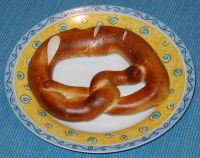
- pretzel n.
- from Brezel, Bretzel, Pretzel "pretzel": a
bakery product in a particular shape; this shape [< Middle High
German prezel, prezile, brezel < Old High German brezzila,
brezitel, brezitella < Middle Latin bracellus
"bracelet" or Latin brachiatus "having branches
like arms" < Latin brachium, bracchium
"arm"].
- "Robbie's [the robot's] chrome-steel arms (capable of
bending a bar of steel two inches in diameter into a pretzel) wound
about the little girl gently and lovingly, and his eyes glowed a deep,
deep red." Isaac Asimov, I, Robot, 1950, p. 28.
- "Along Getreidegasse, the site of Mozart's birthplace,
every shop had one of those hanging pretzel signs above the door,
including, God help us, the local McDonald's (the sign had a
golden-arches M worked into its filigree), as if we were supposed to
think that they have been dispensing hamburgers there since the Middle
Ages." Bill Bryson, Neither Here Nor There: Travels in
Europe, 1991, p. 252.
- "'Aside from an occasional visit to the Loewen Garden
"over the Rhine," with a glass of beer and a few pretzels,
consumed while listening to the excellent music of a German band, the
theatre was the sum and substance of our innocent dissipation.'"
Frank Lewis Dyer and Thomas Commerford Martin, Edison: His Life and Inventions, 1910.
- "'I 'spect the tickets cost a heap,' he thought
ruefully, as he drew himself up into a regular pretzel of a boy; 'but,
then, she never does have no fun, an' never gits a thing fer
herself.'" Alice Caldwell Hegan, Mrs. Wiggs of the Cabbage Patch, 1902.
- Pretzel Logic: A Novel, by Lisa Angowski
Rogak Shaw, 1999.
- More books and products related to pretzel
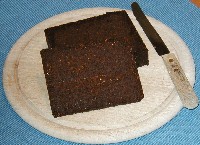 pumpernickel n.
- from pumpern "to break wind" + Nickel "a goblin; devil; kobold": a coarse, dark bread reputed
to be hard to digest.
Please do not plagiarize. If you would
like to use this information in a print or electronic publication,
please ask me for
permission first and cite this page as:
Knapp, Robbin D. 2009.
"GermanEnglishWords.com:
P". In Robb:
GermanEnglishWords.com. Jan. 2, 2009.
You can order most of the cited books and other media through Amazon simply by clicking on the titles.

 The Miniature Pinscher: Reigning King of
Toys, by Jacklyn E. Hungerland, 2000.
The Miniature Pinscher: Reigning King of
Toys, by Jacklyn E. Hungerland, 2000.