
 Rapunzel n.
- a German fairy tale; the main character of that tale [<
German Rapunzel, Rapunze, Rapünzchen, Rapünzlein "lamb's
lettuce" < Medieval Latin rapuncium].
- "That first day, the day when he lifted her up into his
tree as if the breeze was blowing right through her, she'd felt like
the heroine of some fairy tale, like Rapunzel—or no, that wasn't
right. Like Leda maybe, Leda all wrapped in feathered glory."
T.C. Boyle, Drop
City, 2004, p. 39.
- More books and products related to Rapunzel
- Rassenhygiene
n.
- "race hygiene": racial cleansing [< Rasse
"race" < French race "race" <
Italian razza "race" + Hygiene
"hygiene" < Greek hygieinós
"promoting health" < hygiés "healthy,
good"].
- "To cite only the most flagrant example, the Third Reich's policy of Rassenhygiene offered
what purported to be a rational, scientific solution to the problem of
large numbers of inferior and undesirable people." Jonathan
Marks, What
It Means to Be 98% Chimpanzee, 2003, p. 277.
- raster n.
- from Raster "screen": a rectangular pattern
of parallel lines composed of dots or pixels, grid [< German Raster
"screen" < Latin raster, rastrum "rake"
< radere "to scrape"]. This entry suggested by Jan Neidhardt.
- "There are two basic approaches to character
representation. The first is called a raster or bitmap font, where
each character is represented by the on pixels in a bilevel pixel grid
pattern called a bitmap (see Fig. 3-20)." Zhigang Xiang & Roy
A. Plastock, Schaum's
Outline of Computer Graphics, 2000, p. 45.
- "The lines produced by vector drawing programs are based
on mathematical formulas and usually print or plot better than those
of raster images." Francis D. K. Ching, Architectural Graphics, 2002, p. 17.
- "When proofing a page layout via a PostScript printer,
the image and text data in the layout are processed separately by a
Raster Image Processor (RIP) which is either on the same machine or a
remote computer." Martin Evening, Adobe Photoshop CS2 for Photographers: A
Professional Image Editor's Guide to the Creative Use of Photoshop for
the Macintosh and PC, 2005, p. 552.
- "Geospatial data is traditionally divided into two great
classes, raster and vector." Michael Worboys
& Matt Duckham, GIS: A Computing Perspective, 2004, p.
16.
- "The process of working your way down the page in a
series of horizontal sweeps is what a nerd would call raster-scanning,
or just rastering." Neal Stephenson, Cryptonomicon, 2002, p. 434.
- "The U.S. Geological Survey offers digital maps known as
digital raster graphic (DRG)." Jack W. Peters, Complete Idiot's Guide to Geocaching,
2004, p. 207.
- "Anamorphic squeeze: Often called raster squeeze, this
is a neat trick that lets you watch anamorphic DVDs at full resolution
on 4:3 aspect ratio, direct-view TVs." Danny Briere & Pat
Hurley, Home Theater for Dummies, 2003, p. 158.
- More books and products related to raster
-
Realpolitik, realpolitik, realpolitik n.
- "realistic politics": practical politics, usually a
euphemism for Machtpolitik. See
also Ostpolitik, Weltpolitik and Westpolitik.
- "By the start of the twentieth century, then, the
motives that drove U.S. foreign policy seemed barely distinguishable
from those of the other great powers, driven by realpolitik and
commerical interests." Barack Obama, The Audacity of Hope: Thoughts on
Reclaiming the American Dream, 2006, p. 282.
- "The laws of academic Realpolitik indicated
that if Dempsey didn't get quick promotion, he might leave, whereas
Swallow would stay on, doing his job in the same dull, conscientious
way whether he got promoted or not." David Lodge, Changing Places, 1975, p. 222.
- "Realpolitik, however, was the principal reason for
Constantinople's variety of nationalities." Philip Mansel, Constantinople: City of the World's
Desire 1453-1924, 1998.
- "That's how it looks to Moscow because the realpolitik
is simple: Russia is weak; the new Eastern and Central European
democracies are fragile; Russia has the size, resources and,
historically, the inclination to rise and threaten again."
Christopher Ogden, Time, May
26, 1997, p. 24.
- More books and products related to Realpolitik
- Reich n.
- "empire" (< Middle High German rich,
riche < Old High German rihhi, related to English -ric
in bishopric]. See further example under Gleichschaltung.
- "The leaders of Rome, Greece, the Third Reich, the
British Empire, never saw the onset of decadence and internal rot in
time; we can, and we must, if the United States is not to succumb to
its internal hatreds and moral excesses, to be consumed by its own
self-destruction." Carl Thomas Rowan, The Coming Race War in America: A
Wake-Up Call.
 "His [Bullock's]
dramatic reconstruction of the high-stakes maneuvering for the Reich
chancellorship, which brought Hitler to power in 1933, subverts the
notion of some profound historical inevitability of Hitler by
emphasizing the degree to which pure luck and shabby backstage
scheming played a role in bringing him to office." Ron Rosenbaum,
"Explaining Hitler", The New Yorker, May 1995.
"His [Bullock's]
dramatic reconstruction of the high-stakes maneuvering for the Reich
chancellorship, which brought Hitler to power in 1933, subverts the
notion of some profound historical inevitability of Hitler by
emphasizing the degree to which pure luck and shabby backstage
scheming played a role in bringing him to office." Ron Rosenbaum,
"Explaining Hitler", The New Yorker, May 1995.- "In temperament and outlook [German chancellor Helmut
Kohl] is plainly not a Bismarck, whose Prussian blood-and-iron
politics forged the Second Reich (the first was the Holy Roman Empire,
long lost in medieval mists but not formally declared dead till
1806)." James Walsh, Time, Dec. 30, 1996-Jan. 6, 1997.
- "'The story has nothing which makes the rightest fringe
happy, nothing that is anywhere near a positive view of Hitler and the
Third Reich,' comments Friedman." Ursula Sautter, "Can Der Führer Be Funny?", Time, Aug. 17, 1998.
- "Then, as now, Austria had not fully come to terms with
its role in the crimes of the Third Reich." Andrew Purvis,
"Forward into the Past", Time, Feb. 7, 2000.
- The Rise and Fall of the Third Reich: A
History of Nazi Germany, William L. Shirer, 1991.
- The 12-Year Reich: A Social History of
Nazi Germany 1933-1945, Richard Grunberger, 1995.
- Against the Third Reich: Paul Tillich's
Addresses to Nazi Germany, Paul Tillich et al., 1998.
- reichsmark, Reichmark, RM., r.m.
n. [pl. reichsmarks,
reichsmark, Reichmarks]
- from Reichsmark "imperial mark".
- "Suddenly, a barter economy based more on cigarettes and
candy that [sic] on the nearly worthless Reichmarks left over from
Hitler's Germany, was transformed into a throbbing industrial
engine." Jordan Bonfante, "A German Requiem", Time, July 6, 1998, p. 21.
-
Reichstag n.
- "imperial assembly": the former German assembly or
parliament, the building in Berlin where it met [< Reich
"empire" + Tag "day (of assembly)" <
Middle High German tac < Old High German tag
"daytime, time during which the sun shines", related to
English diet meaning "assembly"].
- "In an avowed protest against the new dome on the
Reichstag, the fiend had attached an explosive device to the dog's
collar." John Irving, The Fourth Hand, 2001, p. 55.
- "Admiral Prince Henry of Prussia did likewise, and the
first act of the Reichstag, after reassembling on Tuesday, was to pass
a standing vote of condolence with the British people in their
distress." Logan Marshall, The Sinking of the Titanic & Great
Sea Disasters: Thrilling Stories of Survivors with Photographs and
Sketches, 1912, p. 228.
- "In Germany the Socialist party became the strongest
faction of the Reichstag, and, in spite of differences of opinion
among its members, it preserved its formal unity with that instinct
for military discipline which characterizes the German nation."
Bertrand Russell, Proposed Roads to Freedom, 1918, p. 56.
- "The writer sat in the visitors' gallery of the
Reichstag when the Socialists were protesting against the torturing of
miserable Herreros in Africa, and he heard the deputies of the Holy
Father's political party screaming their rage like jaguars in a jungle
night." Sinclair Upton, The Profits of Religion, 1918, p. 154.
- "In addition, it was suspected that construction was
being started in advance of the dates scheduled by the German Navy
Law--in advance even of the authorization of funds by the
Reichstag." Jeffrey T. Richelson, A Century of Spies: Intelligence in the
Twentieth Century, 1997.
- "In his Reichstag speech of 6 October 1939, Hitler
reminded his audience that in 1919 Poland had taken German lands
developed over many centuries." Deborah Dwork & Robert Jan
van Pelt, Auschwitz: 1270 to the Present, 1996.
- "In 1911 a measure to repeal paragraph 175 came to a
floor vote in the Reichstag but was defeated." Somin LeVay, Queer Science: The Use and Abuse of
Research into Homosexuality, 1996.
- More books and products related to Reichstag
- rinderpest n.
- from Rinderpest "cattle plague": an acute
infectious disease of cattle, cattle plague.
- "At very long intervals a species may have to face the
onslaught of some entirely new menace, such as the introduction into
Africa of rinderpest in the last decade of the nineteenth century, or
the Black Death in Europe." Leslie Brown, "Population
Control among Large Mammals", in Anthony Allison (Ed.), Population
Control, 1970, p. 93.
- "As a veterinarian formerly involved [in the Serengeti]
in the annual vaccination of cattle against rinderpest (cattle
plague), I would point out that distemper, rinderpest, and human
measles, among others, are believed to be closely related viruses,
capable of jumping from species to species." John F. Callear,
Letter to the Editor, National Geographic, May 1995, unpaged.
- More books and products related to rinderpest
- rollmops, rollmop n.
- from Rollmops "rollmops": marinated herring
fillet rolled around a pickle or onion as an hors d'oeuvre [< German
rollen "to roll" < Old French roller,
roler < Latin *rotulare "roll a wheel or disk"
< rotulus + German Mops "pug dog" <
Low German-Dutch mops < Low German mopen "to
open or twist the mouth", Dutch moppen "to grumble,
to be bad-tempered"]. This entry suggested by Britta.
- "now the woman who's invited me, this donna, she's
leaning against an amp, smoking one of these rollmop
constructions/smiles through the hit, and I smile right back when she
holds out the joint to me", Jeff Noon, Needle in the Groove.
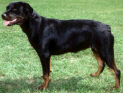
- rottweiler n.
- from Rottweiler "from Rottweil" a breed of
dog named for the German town of Rottweil.
- rucksack n.
- from Rucksack "back sack": backpack.
Incidentally, English knapsack is from the Dutch knapzak
or Low German knappsack and has nothing to do with the Modern
High German Knappe.
- "His [Harry's] Muggle clothing, Invisibility Cloak,
potion-making kit, certain books, the photograph album Hagrid had once
given him, a stack of letters and his wand had been repacked into an
old rucksack." Joanne K. Rowling, Harry Potter and the Deathly Hallows
(Book 7), 2007, p. 20.
- "Shortly after arriving in Cork, we all lost each other
momentarily and cursed Jan for putting his rucksack in with the
baggage." James Hanlon, UK500:
Birding in the Fast Lane, 2006, p. 62.
- "There was water in his bota bag instead of wine (he'd
learned that lesson the hard way, in the Sonoran Desert), and the Army
surplus rucksack on his back contained a sleeping bag, a ground cloth,
a few basic utensils and a damp copy of Steinbeck's Of Mice
and Men." T.C. Boyle, Drop
City, 2004, p. 15.
- "Mrs Weasley was still glowering as she kissed Mr
Weasley on the cheek, though not nearly as much as the twins, who had
each hoisted their rucksacks onto their backs and walked out without a
word to her." J.K. Rowling, Harry
Potter and the Goblet of Fire (Book 4), 2000, p. 65.
 "He carried a rucksack
slung over one shoulder." W.R. Thompson, Infiltrator (Star Trek: The Next
Generation), 1996, p. 14.
"He carried a rucksack
slung over one shoulder." W.R. Thompson, Infiltrator (Star Trek: The Next
Generation), 1996, p. 14.- "Sessine was dressed in plain, utilitarian clothes and
carried a light rucksack across his shoulder." Iain M. Banks, Feersum Endjinn, 1994, p. 179.
- "I lugged my rucksack over to find a young couple
arguing in the front seat." Bill Bryson, Neither Here Nor There: Travels in
Europe, 1991, p. 16.
- More books and products related to rucksack
Please do not plagiarize. If you would
like to use this information in a print or electronic publication,
please ask me for
permission first and cite this page as:
Knapp, Robbin D. 2009.
"GermanEnglishWords.com:
R". In Robb:
GermanEnglishWords.com. Jan. 1, 2009.
You can order most of the cited books and other media through Amazon simply by clicking on the titles.