 über-,
uber-, über prefix, adj.
über-,
uber-, über prefix, adj.- "over-, super-": Used like wunder- as in wunderkind [< German über
"over" < Middle High German über < Old
High German ubar]. Interestingly German-speakers often prefer
Anglicisms and would therefore prefer, for example, Superhacker
to Überhacker, although they would understand both to
mean the same thing. In the same vein the word superman in
English originates as a direct translation (loan translation) of the
German Übermensch, but one hears Superman much
more often in German. Note from the examples that there is no consensus
on how to spell über-. Sometimes it is written as one or
two words or hyphenized, with or without italicization and with or
without the umlaut. My preference is to
hyphenize, italicize and umlaut it. See also "Deutschland über
alles".
- "Über Bermuda, Dad." Jerry Scott & Jim
Borgman, Zits comic strip, Jun. 16, 2004.
- "You want to be the guy to outbully the überbully."
Ben Elton, Past Mortem, 2004, p. 374.
- "Uber-skate journalist Jacko Weyland checks in on the
state of the nation..." "Skaters eye", Thrasher Magazine, May 2002.
- "Frazier asked über-agent Amanda Urban to
put up his book for auction so early because he wanted to choose an
editor carefully." Malcolm Jones, "King of the
Mountain" (review of Cold Mountain by Charles Frazier), Newsweek, Apr. 22, 2002, p. 65.
- "This all sounds über-romantic."
Adele Parks, Larger than Life, 2002, p. 11.
- "Uber-ISP AOL has teamed up with mobile phone king Nokia
to produce a cut-down version of the Netscape browser for WAP
devices." "Uber-ISP AOL", Internet Magazine,
Mar. 2001.
- "Uber-Guber Goes Multimedia" (filmmaker Peter
Guber), Charles Lyons, Variety, Aug. 23, 1999.
- "Two years ago, when the capture of America's best-known
computer criminal, Kevin Mitnick, was front-page news, it was Littman
who got the über-hacker's inside story and wrote a book,
The Fugitive Game, that was sympathetic
to Mitnick." Joshua Quittner, Time, May 5, 1997, p. 48.
- ... über alles,
... uber alles
- "... over everything": When used in phrases like
"now he's become the boss über alles" or "it seems
like its Shaq and the Lakers über alles", "... über
alles" is derived from "Deutschland
über alles", which see. This entry and examples suggested by
Wilton Woods.
- "Distribution Uber Alles" (German giant
Bertelsmann's digital distribution plans), Brad King, Variety, Dec. 18, 2000.
-
 U-boat n.
- from U-Boot "submarine": submarine [short
for German Unterseeboot "undersea boat"].
- "During World War I, Woodrow Wilson avoided American
involvement until the repeated sinking of American vessels by German
U-boats and the collapse of the European continent made neutrality
untenable." Barack Obama, The Audacity of Hope: Thoughts on
Reclaiming the American Dream, 2006, p. 282.
- "Maybe next time I'll try 'UFOs', 'U-boats' or 'We're
trying to see Spain' [in answer to the question, 'Excuse me, what are
you looking at?']." James Hanlon, UK500:
Birding in the Fast Lane, 2006, p. 86.
- "The road felt frictionless, as if I were at the wheel
of a destroyer on the North Atlantic, and the shapes in the mist off
to starboard weren't farmhouses but cargo ships in the convoy, and the
windshield wiper was a sonar antenna tracking German U-boats."
Garrison Keillor, Wobegon Boy, 1997, p. 164.
- "On January 13, 1940, Hitler ordered a military
committee to research the feasibility of military action in the north,
with an eye to the Norwegian ports of Narvik and Trondheim for use by
Admiral Karl Dönitz's U-boat force." Eloise Engle &
Lauri Paananen, The Winter War: The Soviet Attack on
Finland 1939-1940, 1973, p. 120.
- "'You have a long coast line and you may need the U-boat
yourself some day.'" Henry Morgenthau & Ara Sarafian, Ambassador Morgenthau's Story, 1918.
- "Ever since entering the U-boat zone we had been on the
lookout for periscopes, and children that we were, bemoaning the
unkind fate that was to see us safely into France on the morrow
without a glimpse of the dread marauders." Edgar Rice Burroughs,
The Land That Time Forgot.
- More books and products related to U-boat
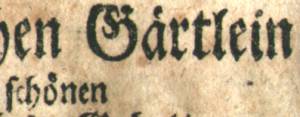
From a book published in 1732. One can see the
superscript "e" used as an umlaut in Gärtlein
"little garden" and schönen
"beautiful". |
- umlaut n., v.t.,
umlaut-mark n.
- from Umlaut "change of sound": also called
vowel modification, mutation or inflection; the change of a vowel sound
(e.g., mouse—mice, goose—geese,
langlauf—langläufer); the vowel altered in
this way; the diacritical mark consisting of two dots (¨)
over a modified vowel; to modify by umlaut; to write an umlaut over.
[German < um- "about, changed" < Middle High
German umbe < Middle High German umbi + Laut
"sound" < Middle High German lut, coined by Jacob
Grimm of the Brothers Grimm.] This entry suggested by Aldorado
Cultrera.
The diacritic marks umlaut and dieresis [chiefly Am.]
(also spelled diaeresis [chiefly Br.]) are identical in
appearance but different in function. The dieresis (Greek "to take
apart") indicates that the vowel so marked is to be pronounced
separately from the one preceeding it (e.g., naïve,
Noël) or that the vowel should be sounded when it might otherwise
be silent (e.g., Brontë).
The origin of the German umlaut is an abbreviated "e", i.e.
the vowel is influenced by the following (semi-)vowel "e" in
a process called apophany, therefore the correct transliteration of an
umlaut is to use an "e" after the vowel. Umlauts occur mostly
in Germanic languages but also for example in Finnish. When German
words with umlauts are assimilated into the English language, they
sometimes keep their umlauts (e.g., doppelgänger,
Flügelhorn, föhn, Der Freischütz, führer, jäger, kümmel, Künstlerroman, schweizerkäse, über-), but often are simply written
without the diacritic (e.g., doppelganger,
flugelhorn, Der Freischutz, yager), and less often are
correctly transliterated using an "e" (e.g., foehn, fuehrer,
jaeger, loess).
Of course, sometimes more than one spelling makes its way into English.
Muesli could have originated
from Müesli or Müsli, so it's not clear if
the umlaut was lost or transliterated.
- "You form these mutated plurals simply by changing the
vowel sound of the singular, in a process called 'umlaut'."
 Mignon Fogarty, "What Is the Plural of 'Mouse'?", episode 135 of
the podcast Grammar Girl's Quick and Dirty Tips for
Better Writing, Sept. 16, 2008.
Mignon Fogarty, "What Is the Plural of 'Mouse'?", episode 135 of
the podcast Grammar Girl's Quick and Dirty Tips for
Better Writing, Sept. 16, 2008.
- "Simeon Potter believed that English spelling possessed
three distinguishing features that offset its other shortcomings: The
consonants are fairly regular in their pronunciation, the language is
blessedly free of the diacritical marks that complicate other
languages—the umlauts, cedillas, circumflexes, and so
on—and, above all, English preserves the spelling of borrowed
words, so that people of many nations 'are immediately aware of the
meanings of thousands of words which would be unrecognizable if
written phonetically.'" Bill Bryson, The Mother Tongue: English and How It
Got that Way, 1990, p. 121.
- "'Now you look like a German in American clothes. I
don't know—I do believe it's your face, Ted. I wouldn't have
thought that ten years or so in any country could change the shape of
one's nose, and mouth and cheekbones. Do you suppose it's the
umlauts?'" Edna Ferber, Fanny Herself, 1917.
- "Because of my frequent need to use the Umlaut (ve must
have capitals for a noun, pleess), my face has become so distorted and
angry-looking and I might immediately be found out to be a
German!" "Umlaut
and about", The Dominion, Sep. 9, 2000.
- "The Department of Internal Affairs is sticking by its
decision which effectively changes the surname of a a [sic] Swiss
family who gained New Zealand citizenship last week. The [Yvonne]
Kuenzi family's correct name has no letter e but an umlaut—two
dots above the u—which is used in Germanic languages to indicate
a change of vowel or sound." Anonymous, "Change
of family's name is 'policy'", Nelson Mail,
Nov. 9, 1998.
- 'With that umlaut over the n it means "began to
disintegrate;" without the umlaut, the word is an active
transitive past participle, and means that the disintegration has been
completed; thus it means—substantially—that the man is dead:
but not exactly that, but not really, because in Blitzowski,
as I have previously remarked, there is no such thing as death.' Mark
Twain, "Three Thousand Years among the Microbes", The Devil's Race-Track: Mark Twain's
"Great Dark" Writings, 2005, p. 185. Here Twain's character
is speaking of the imaginary language of the microbes.
- More books and products related to umlaut
- Unruhe n.
- from Unruhe "unrest, restlessness,
commotion": the title of season
4, episode 2 of the TV series The X-Files [< German un-
"un-" + Ruhe "rest" < ruhen
"to rest" < Middle High German ruon, ruowen <
Old High German ruowen, ruowon]. This entry suggested by CauNo.
- ur-, Ur- prefix
- "original, primitive, ancient" [< German ur-
"the original condition or first representative of a thing"
< Middle & Old High German ur- "out (of)"].
- "They certainly looked like Ur-bats, the original bats,
the bats of prehistory, their slow, labored flapping interspersed with
ungainly glides, and indeed perhaps they were a species of leaf-nosed
bat, not much altered from their fossil ancestors of sixty million
years ago and probably earlier–seventy to 100 million years
ago–early enough to have been catching insects in the evening
over a shallow lake full of dinosaurs." Redmond O'Hanlon, No Mercy: A Journey Into the Heart of
the Congo, 1998, p. 180.
- "'I know what he did to the first author, the ur-Horace
Jacob Little.'" David Czuchlewski, The Muse Asylum, 2001, p. 79.
- "He was holding up a steaming coffee cup, white and
smoothly iconic, in a big, white-gloved, three-fingered ur-Disney
hand." William Gibson, Idoru, 1997, p. 34.
 "Trevor-Roper was not
writing fiction, of course, but his spellbinding, cinematic vision of
Hitler, Rosenfeld argues, became the defining image, the ur-Hitler for
the decades of pulp fiction and film that followed." Ron
Rosenbaum, "Explaining Hitler", The New Yorker, May 1995, p. 60.
"Trevor-Roper was not
writing fiction, of course, but his spellbinding, cinematic vision of
Hitler, Rosenfeld argues, became the defining image, the ur-Hitler for
the decades of pulp fiction and film that followed." Ron
Rosenbaum, "Explaining Hitler", The New Yorker, May 1995, p. 60.- "Even the 'Ur-Alphabet', namely the Phoenician,
developed from several sources." Niklaus Shaefer, "Spelling Systems have always been mixes and
have drawn ideas from multiple sources", Journal of the Simplified Spelling
Society, 2001/2.
Please do not plagiarize. If you would like to
use this information in a print or electronic publication, please ask me for permission
first and cite this page as:
Knapp, Robbin D. 2009.
"GermanEnglishWords.com:
U". In Robb:
GermanEnglishWords.com. Jan. 6, 2009.
You can order most of the cited books and other media through Amazon simply by clicking on the titles.