"When Austria's Jörg Haider commended Hitler's
'orderly' employment policies and praised former members of the Waffen
SS as 'decent men of good character' he was an ambitious outsider from
Austria's rural Carinthia province looking for a way to broaden his
appeal to older voters." Andrew Purvis, "Forward into the
Past", Time,
Feb. 7, 2000.
from Waldmeister "forest master": an Old
World flower and herb, sweet woodruff, Galium odoratum; an
operetta by Johann Strauss II, 1895 [< German Wald
"woods, forest" < Middle High German walt <
Old High German walt + Meister, see -meister].
"There are many classic and traditional 'bowlen' in
Germany, and peaches, pineapple, or 'waldmeister' (woodruff) may be
used instead of strawberries." Katherine Burton & Helmut
Ripperger, Feast Day Cookbook.
"forest death": the dying of forest ecosystems by
acid rain or other forms of pollution, first described in Germany and
the former Czechoslovakia.
"Waldsterben—the death of forests from air
pollution—is costing Europe (including Russia) at least $29
billion annually in lost timber, tourism, manufactured goods and other
social benefits—losses that may continue for the next
century." Don Hinrichsen, "Computing the Risks: A Global
Overview of our Most-pressing Environmental Challenges" International
Wildlife, Mar.-Apr. 1996, p. 28.
from walzen "to roam, travel around,
waltz": a certain dance, to do the dance, to cause to do the
dance, pertaining to the dance, also fuguratively. A waltzer
is one who waltzes, although in German Walzer is the dance
itself. See further examples under schottische
and polka.
"'I like this one,' said Luna, swaying in time to the
waltz-like tune, and a few seconds later she stood up and glided on to
the dance floor, where she revolved on the spot, eyes closed, and
waving her arms." J.K. Rowling, Harry Potter and the Deathly Hallows
(Book 7), 2007, p. 123.
"On the third day of my hospital stay, my surgeon came
waltzing into my room, all chipper and smiles, followed by Doctor #8,
the gynecologist who'd finally diagnosed me." Fran Drescher, Cancer Schmancer, 2002, p. 132.
"If the Cardassians waltz away with the photonic pulse
cannon, do you think they're going to admit to us that it's a piece of
junk?" Dafydd ab Hugh, Balance of Power (Star Trek: The Next
Generation), 1995.
"Hector was doing
obese male exhibitionists who enjoy putting on organdy tutus and
dancing to the 'Waltz of the Sugarplum Fairy' in public and were
pleased to do so on his show..." Garrison Keillor, "The
Chuck Show of Television", The Book of Guys, 1993.
"The risk was too great: could you imagine yourself
waltzing into the Mem outpatient clinic and waltzing out with a box of
morphine bottles under your arm?" Michael Crichton writing as
Jeffery Hudson, A Case of Need, 1968.
"Ten minutes after that she would be home, and the
husband would be there to greet her; and even a man like Cyril,
dwelling as he did in a dark phlegmy world of root canals, bicuspids,
and cares, would start asking a few questions if his wife suddenly
waltzed in from a week-end wearing a six-thousand-dollar mink
coat." Roald Dahl, "Mrs Bixby and the Colonel's Coat",
Kiss Kiss, 1959, p. 91.
"No doubt the dogs had found the place where we had
entered the stream, and were now waltzing up and down the shores
trying to pick up the trail again." Mark Twain, A
Connecticut Yankee in King Arthur's Court, 1982, first published 1889,
p. 208.
from Wanderlust "desire to wander": strong
longing to travel. Wandern more often means "to
hike" than "to wander" in German; to emphasize the
difference a German-speaker will say herum wandern, literally
"to wander around".
"Here was another man who didn't share my
wanderlust." Fran Drescher, Cancer Schmancer, 2002, p. 52.
"I look behind me/And I see there's just/Me and the
wanderlust." Mark Knopfler, "Wanderlust", Sailing to Philadelphia, 2000.
"His sense of wonder and awe, his gentle encouragement
toward 'direct experience,' and his simple yet graphic prose will stir
the wanderlust in many a reader." Booklist, a review in: Michael
Crichton, Travels, 1988, p. i.
from wedeln "to wag": a skiing technique
first developed in Austria in the 1950s that consists of high-speed
turns made in succession with both skis parallel while not noticeably
setting the ski edges on a slope. Using this technique one's rear end
wags like a dog's tail [< German wedeln "to wag (the
tail), fan" < Middle High German wadelen, wedelen <
wadel, wedel "fan, tuft of hair" < Old High
German wadal, wedil].
"defense force": the German armed forces before and
during World War II [< German Wehr "defense" <
Middle High German wer, were < Old High German weri,
wari "defense" + Macht "force, might" <
Middle and Old High German maht "ability", related
to English might]. See also Landwehr,
Machtpolitik.
"In the back seat, reading some papers, was – I
swear to God – the famous Dr Kurt Waldheim, the aforementioned
Wehrmacht officer and now president of Austria." Bill Bryson, Neither Here Nor There: Travels in
Europe, 1991, p. 264.
"During World War II, the Soviet Union began to build
what Soviet sources refer to as history's first coalition of a
progressive type when it organized or reorganized the armies of
Eastern Europe to fight with the Red Army against the German
Wehrmacht." Stephen R. Burant, East Germany, a Country Study, 1987.
"Incorporated into the Wehrmacht, the corps was composed
largely of anti-Soviet émigrés who had served in the
armies of the Czar; many of the personnel were incapable of extended
field service, and the Germans generally restricted them to such
security duties as the protection of the vital Belgrade-Nish railroad
line." Robert M. Kennedy, Hold the Balkans!: German Antiguerrilla
Operations in the Balkans 1941-1944.
"One of them was Lieutenant-General Kurt Dittmar, a
fifty-seven-year-old Wehrmacht officer who had made a name for himself
broadcasting communiques from the front and was known everywhere as
the 'voice of the German High Command'." Ada Petrova & Peter
Watson, The Death of Hitler: The Full Story With
New Evidence from Secret Russian Archives, 1995.
"The entire Western campaign of 1940 had cost the
Wehrmacht only 156,000 casualties (with 30,000 dead)." Howard
Andrew G. Chua-Eoan, "War in Europe", Time, Dec. 2, 1991, p. 62.
from Der Weihnachtsbaum "The Christmas
Tree": set of 12 piano pieces by Liszt, composed 1874-1876 [<
German der "the" + Weihnacht "Holy
Night, Christmas Eve" + Baum "tree"].
"She hesitated, searching her memory for a good Liszt;
then softly she began to play one of the twelve pieces from Der
Weihnachtsbaum." Roald Dahl, "Edward the Conqueror", Kiss Kiss, 1959, p. 171.
from Weismannismus "Weissmannism": the
theory that the contents of ova and sperm are not affected by other
changes in the body, thus ruling out the possibilty of inheriting
acquired characteristics from one's parents, a key element of
neo-Darwinism [August Friedrich Leopold Weismann (1834–1914), the
German biologist who propounded this principle < German weise
"wise" + Mann "man"].
"Publications [of the fictitious George
Challenger]: 'Some Observations Upon a Series of Kalmuck Skulls';
'Outlines of Vertebrate Evolution'; and numerous papers, including
'The Underlying Fallacy of Weissmannism,' which caused heated
discussion at the Zoological Congress of Vienna." Arthur Conan
Doyle, The Lost World, 2004, p. 12.
"world view": one's philosophy or conception of the
universe and of life, a particular attitude toward life and reality.
The difference between Anschauung and Ansicht is the
same as that between look and see. This entry
suggested by David.
"The
ideological school plumbed the equally murky depths of his [Hitler's]
prose and claimed to find in his feverishly logorrheic discourse an
intellectual coherence, a serious Weltanschauung that was the true
engine of his murderous acts." Ron Rosenbaum, "Explaining
Hitler", The New Yorker, May
1995.
"Germany's Weltpolitik was an implicit threat
to the hegemony of Great Britain, which at the turn of the century was
still the pre-eminent imperial power." Misha Glenny, The Balkans: Nationalism, War & the
Great Powers, 1804-1999, 2001, p. 309.
from Weltschmerz "world pain": sorrow which
one feels and accepts as his necessary portion in life; mental
depression or apathy caused by comparison of the actual state of the
world with an ideal state; sentimental pessimism or sadness. This entry
suggested by Frank
Weller. See also angst.
"As the door burst open, Verkramp peered up through the
torn vermillion flounces with all the Weltschmerz of a
decapitated Rhode Island Red." Tom Sharpe, Indecent Exposure, 1973, p. 50.
"Carol was plunged back into last night's Weltschmerz."
Sinclair Lewis, Main Street, 1920.
from Westpolitik "western politics": a
policy of a Communist country of adopting trade and diplomatic
relations with non-Communist nations [< German West
"west" + Politik "politics, policy"]. See
also Machtpolitik, Ostpolitik, Realpolitik and Weltpolitik.
from Wiener Wurst "Viennese (sausage)": a
kind of sausage used in hotdogs, a frankfurter,
not to be confused with what Americans call Viennese sausages,
which are pretty much the same thing but smaller and canned in liquid.
Austrians call wieners Frankfurter (Würste). I've never
seen Viennese sausages in Vienna. See further example under sauerkraut. See also Wiener schnitzel and wurst.
"Did he fall into his wienie fire and get all singed
around the ears?" T.C. Boyle, Drop
City, 2004, p. 162.
"Cooking chicken thighs recently, I caught the exact
aroma of a Balboa wienie roast, when the fire was ready and the first
wienies were deployed above it on long forks with wooden
handles." Paul Fussell, Doing Battle: The Making of a Skeptic,
1998.
"He bought one and it didn't taste like dog meat at all;
it reminded him, instead, of a cross between salami and a German
wiener." Rosario Ferre, The House on the Lagoon, 1995.
"With Casey prostrate in the dirt amid the screams and
jeers/We threw wieners down at him and other souvenirs." Garrison
Keillor, "Casey at the Bat (Road Game)", The Book of Guys, 1993.
"In Austria, noted for its tasty sausages (Würstel),
the word for Vienna is Wien, and for Viennese, Wiener.
It is easy to see where 'wienie' comes from." George W. Long,
"Occupied Austria, Outpost of Democracy" National Geographic, Jun. 1951, p. 766.
"Author Frederick Simpich was aghast at buildings shaped
like 'owls, derby hats, shoes, airships, dogs, teakettles, windmills,
mosques, wienerwursts, zeppelins, and igloos.'" "From our
Archives: Dog Gone" National Geographic, Nov. 2000, p. 135. Original
quote from 1934.
"He seemed to tower over the pitcher—Red was six
feet one—and he scowled and shook his bat at Wehying and called,
'Put one over—you wienerwurst!'" Zane Grey, The Redheaded Outfield, 1915.
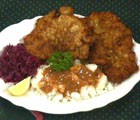
from Wiener Schnitzel "Viennese cutlet": a
thin breaded cutlet traditionally of veal but more usually of pork and
sometimes turkey. See further examples under bratwurst and stein.
"Dirndls, Mozart, The
Sound of Music—genug! Enough already. It gets cloying, like being
presented with an extra-large Salzburger Nockerln after too much
Wiener schnitzel." Roger Kimball, "Salzburg, for Real",
National Review, Sep. 17, 2001.
"With the increasing interest in beef and other meats,
Wiener Schnitzel and other veal dishes are in demand." Florence
Fabricant, "As German and Austrian cuisines gain in popularity,
schnitzel waltzes onto menus", Nation's Restaurant News, Mar. 6, 2000.
from Wirtschaftswunder "economic miracle":
the fast rise of the economy in West Germany in the fifties and sixties
[< German Wirtschaft "economy" + Wunder,
"miracle, wonder"]. See also Frauleinwunder and wunderkind. This entry suggested by Bastian Sick.
"Ruff's photographs from the 1980s of corporate and
industrial architecture in Germany's Ruhr area were already mediated
by other depictions of such buildings: picture postcards from the
fifties and sixties, with which companies advertised their prosperity
of the Wirtschaftswunder (industrial miracle, or boom) years."
Sven Lutticken, "Haunted space", Afterimage, Sep.-Oct. 2002.
"Postwar Germany, absorbed in rebuilding and mesmerized by its prodigious
Wirtschaftswunder, deliberately forgetful of both the horrors it had
caused (Auschwitz, etc.) and those it had suffered (Dresden, etc.),
was unthinkable as a homeland." Peter Heinegg, "Memory's
martyr", Cross Currents, Spring 2002.
"They regard the old D-mark
as the creator of dos [sic] Wirtschaftswunder (the economic boom) and
question whether it is any accident that monetary union has coincided
with Germany experiencing economic decline of a type that has left it
struggling to comply with EU rules on debt as a proportion of national
income." Tim Luckhurst, "A reluctant people see the bigger
picture", New Statesman, Jan. 7, 2002.
"It has also, along with the Bundesverfassung (the
Federal Constitution), been one of the few acceptable tokens of
national pride, as the emblem and motor of the Wirtschaftswunder, the
'economic miracle' that saw Germany become the most powerful economy
in Western Europe." Jonathan Williams & Andrew Meadows,
"Europe's national currencies: Jonathan Williams and Andrew
Meadows review the history of the various currencies being replaced by
the Euro", History Today, Jan. 2002.
"The German population is rapidly aging, the country's
wage bargaining, labor rules, and product market regulations came from
another era, and Germany's days as a Wirtschaftswunder are long
gone." Adam S. Posen, "Who's the comeback kid? France,
Germany, and Italy are struggling to recover. Who'll come out on
top?" The International Economy, Fall 2003.
"Walther Groz belonged to the large number of
entrepreneurs who were the driving force of Germany's
Wirtschaftswunder in the 1950s and 1960s." Jurgen Hambrecht, as
quoted in "Gaining executive mindshare: US and European chemical
CEOs", by Cynthia Challener, Chemical Market Reporter, May 26, 2003.
related to Wrack "wreck": ruin;
destruction, now chiefly in the phrase wrack and ruin; wreck;
wreckage; seaweed or other marine plant life cast up on shore. One of
the several meanings of Modern English wrack comes from Low
German wrak and is similar in spelling, meaning and origin to
Modern German Wrack.
"The study of algae is called phycology (from the Greek
phykos, meaning seaweed) or algology (from the Latin alga,
meaning sea wrack)." Paul C. Silva, "Algae", Microsoft® Encarta® 96 Encyclopedia.
"In the longer run, British rule brought widespread
administrative and social modernization to a land that, except for the
benign efforts of King Mindon, the builder of Mandalay, had been
swamped in reclusive policies and wracked by court intrigues."
James F. Guyot, "Burma", Microsoft® Encarta® 96 Encyclopedia.
"From the fabric of the beach, wrack and wreckage of the
world before things changed." William Gibson, Idoru, 1997.
"Harry?
Harry, 19, wunderkind!" Liev Schreiber as Ted Fielding in Sphere, produced by Michael Crichton,
1998.
"Classmates Shamed By Wunderkid's Incredible
Talent", Bill Watterson, Calvin and Hobbes comic strip, May 6,
1993.
"When the half-year hazing was over, Lovell, it was
announced, had finished first in his class, edging out even such Pax
River wunderkinder as Wally Schirra and Pete Conrad." Jim Lovell
& Jeffrey Kluger, Apollo 13, 1995. This example
illustrates the correct German plural of the word.
"Then those of my dear neighbors nearest my heart
decided to prevent a lonely Christmas for me, so on December 21st came
Mrs. Louderer, laden with an immense plum pudding and a big 'wurst,'
and a little later came Mrs. O'Shaughnessy on her frisky pony, Chief,
her scarlet sweater making a bright bit of color against our
snow-wrapped horizon." Elinore Pruitt Stewart, Letters of a Woman Homesteader, 1847.
"'Winnies! Here's your hot winnies! Hot winny-wurst!'"
Booth Tarkington, Penrod, 1914.


 Waffen
SS n.
Waffen
SS n.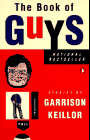 "Hector was doing
obese male exhibitionists who enjoy putting on organdy tutus and
dancing to the 'Waltz of the Sugarplum Fairy' in public and were
pleased to do so on his show..." Garrison Keillor, "The
Chuck Show of Television", The Book of Guys, 1993.
"Hector was doing
obese male exhibitionists who enjoy putting on organdy tutus and
dancing to the 'Waltz of the Sugarplum Fairy' in public and were
pleased to do so on his show..." Garrison Keillor, "The
Chuck Show of Television", The Book of Guys, 1993.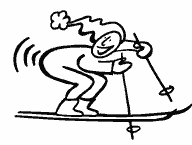 wedeln
n.
wedeln
n. Weismannism, weismannism,
Weissmannism, Weismann's
theory n.
Weismannism, weismannism,
Weissmannism, Weismann's
theory n. "The
ideological school plumbed the equally murky depths of his [Hitler's]
prose and claimed to find in his feverishly logorrheic discourse an
intellectual coherence, a serious Weltanschauung that was the true
engine of his murderous acts." Ron Rosenbaum, "Explaining
Hitler", The New Yorker, May
1995.
"The
ideological school plumbed the equally murky depths of his [Hitler's]
prose and claimed to find in his feverishly logorrheic discourse an
intellectual coherence, a serious Weltanschauung that was the true
engine of his murderous acts." Ron Rosenbaum, "Explaining
Hitler", The New Yorker, May
1995.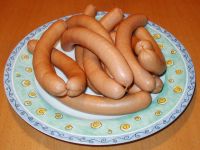
 Wiener
schnitzel, Wiener
Schnitzel, schnitzel n.
Wiener
schnitzel, Wiener
Schnitzel, schnitzel n. "Harry?
Harry, 19, wunderkind!" Liev Schreiber as Ted Fielding in Sphere, produced by Michael Crichton,
1998.
"Harry?
Harry, 19, wunderkind!" Liev Schreiber as Ted Fielding in Sphere, produced by Michael Crichton,
1998.